Cancelled Too Soon: One Mississippi

This article is part of the Cancelled Too Soon series. Previously, Manhattan.


One Mississippi is a semi-autobiographical sitcom that debuted on Amazon in 2016, based on and starring comedian Tig Notaro, who catapulted to fame when Louis CK commercially released an impromptu stand-up set she performed just after receiving a breast cancer diagnosis. Notaro plays a talk radio host called Tig Bavaro, who similarly develops breast cancer and loses her mother within a few months. While in her hometown of Bay St. Lucille, Mississippi following her mother’s funeral, Tig records her radio show with local producer Kate, with whom she develops a mutual attraction, even though Kate is ostensibly straight. (Kate is played by Notaro’s real wife Stephanie Allynne. They met while shooting a movie and Allynne did not date women before Notaro.) Tig gets a stomach infection that nearly kills her and requires a faecal transplant to treat. She has a brother with a French first name (Renaud/Remy) and a very reserved stepfather she has trouble connecting with. All of this is lifted from Tig Notaro’s life, albeit with names changed, events moved around in time a little and more dramatic character arcs.

But, so far as Notaro has said, the central dramatic fact of One Mississippi is fiction: Tig Bavaro was sexually abused by her grandfather as a child. It’s not the only thing the show is about, by any means, but it’s the axle the central story revolves around, the source of the core dramatic conflicts in the Bavaro family. Tig’s grief and illness are just a starting point – the narrative arc of the show’s two seasons is about sexual abuse and rape culture more generally, and each season ends with Tig taking a step towards processing her feelings about it. One Mississippi received widespread critical acclaim, and rightly so, with much of the praise, especially for season two, directed towards its portrayal of sexual violence and how society enables it.

It’s a very dry, very funny show, even with its often-dark subject matter, but it’s not a black comedy. Tig sometimes makes blackly comic jokes, and there are a couple of Scrubs-esque imagination spots that go very dark, but the tone of the show is mostly pretty relaxed and light, even if there’s narrative tension building up under the surface at all times. When it swings into the dramatic, you feel the shift, you know it’s accelerating, but its resting speed is a nice, gentle hum. I’ve rewatched One Mississippi from start to finish several times and I just enjoy it more and more. It’s somehow both a fun, easy watch and a show that makes me cry several times per season.

One Mississippi was cancelled after its second season in galling circumstances.

Continue reading “Cancelled Too Soon: One Mississippi”

Gutless, Spineless, Gormless, Directionless, Neurotic, Underachieving, Cowardly Pile of Smeg: The Arnold J. Rimmer Story

In the long and strange history of Red Dwarf – spanning thirty years and two television channels, surviving the departure and return of one of its leads, the permanent departure of one of its creators and fifteen years of being terrible before suddenly, inexplicably, blessedly becoming good again – it’s always been, at its heart, an odd couple sitcom. It takes extreme versions of the Felix and Oscar archetypes and drops them into a high-concept sci-fi premise. Dave Lister (Craig Charles), a disgusting slob, is the last man alive after spending three million years in stasis aboard the Red Dwarf mining ship. Arnold Rimmer (Chris Barrie), an anal-retentive coward, was one of Lister’s crewmates, who the ship’s computer revives as a hologram to keep Lister company. The computer picks Rimmer because he’s the person Lister exchanged the most words with in his time on Red Dwarf, not factoring in that all of those words were antagonistic.

Even as Red Dwarf became more and more of an ensemble – there’s Cat (Danny John-Jules), the end result of three million years of evolution from Lister’s pregnant cat, Kryten (Robert Llewellyn), a service robot the Red Dwarf boys rescue, and the ship’s computer Holly, who is sometimes Norman Lovett and sometimes Hattie Hayridge and sometimes entirely absent for seasons at a time – the dynamic between Rimmer and Lister remained the show’s beating heart. (Which is one of the many reasons the season where Rimmer leaves sucks.) They bicker endlessly, and are at times astonishingly cruel to one another. But the arc of the show is their becoming best friends: not because either of them “develop” or become better people, really, but because they get to know one another inside out. They are, after all, the only two human beings left, even if one of them isn’t technically alive.

Continue reading “Gutless, Spineless, Gormless, Directionless, Neurotic, Underachieving, Cowardly Pile of Smeg: The Arnold J. Rimmer Story”

The Best of The Sundae #2

It’s been over a year since we first took a look back at our work and picked the best of it for your easy reading pleasure. A lot has happened since then. We’ve gone through two whole Oscar and Emmy cycles. We each had an essay published in Bright Wall/Dark Room – Dean on Blade Runner and Ciara on Weekend at Bernie’s II. Marvel fired James Gunn due to an alt-right smear campaign and now he’s writing Suicide Squad 2. We were shortlisted for an Irish Blog AwardJonathan Chait got BOFA’d.

But, most importantly, we kept writing and publishing, and now we have even more stuff to choose from for our second best-of round-up. So, if you’re a long-time reader, here’s an invitation to revisit the classics. If you’re a recent reader, catch up on some stuff you might not have read. And if you’re a brand new reader, take a crash course in what we’re all about.

Here’s the best of The Sundae so far. Again.

Continue reading “The Best of The Sundae #2”

Behold the Man Who Is a Bean

Night on a deserted street in London. Saint Paul’s Cathedral shines on the horizon. A beam of light shoots down from the sky and expands into a spotlight. A man falls from above and lands smack on the ground. He wears a tweed jacket and red tie, brown slacks and a white shirt. An angelic choir begins to sing in Latin.

Ecce homo qui est faba.

“Behold the man who is a bean.”

Continue reading “Behold the Man Who Is a Bean”

A Mid-Life Crisis in North Dakota

Dennis Reynolds is a bad man. All the characters on It’s Always Sunny in Philadelphia are awful people – it’s kind of the premise of the show – but Dennis still stands apart. Like the rest of the Gang, he’s all narcissism, bigotry, and rage, ready to explode at any moment at anyone he perceives to have crossed him. Once, when a guy called him a narc, Dennis’s revenge was getting the guy to chain himself to a tree overnight during a storm while Dennis slept with his girlfriend, and that’s pretty mild when you’re grading on the Dennis curve of bad behaviour. He’s a prolific rapist, and he might be a serial killer.

He’s also one of the best characters in the history of TV.

Continue reading “A Mid-Life Crisis in North Dakota”

What About Me? What Am I Going To Do?

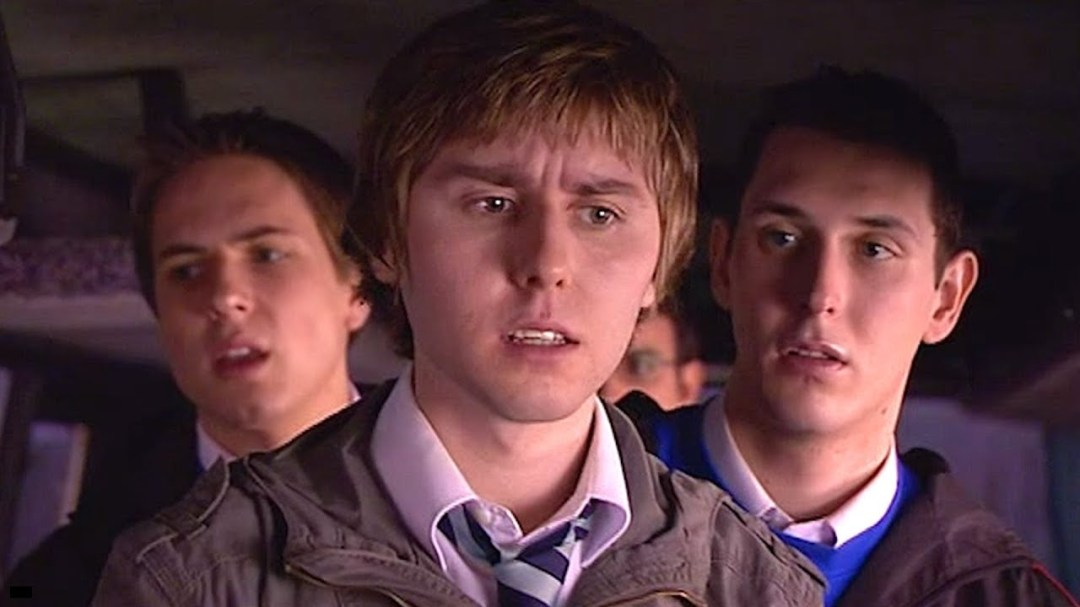
Rewatching The Inbetweeners in 2018 has been full of surprises. Mostly, I was taken aback by how evocative it is of its time. I rarely think of the late 2000s as having any kind of distinct culture – it seems most of the time that we haven’t had a decade, in a cultural sense, since the 1990s – but The Inbetweeners looks and feels like a show made very specifically between 2008 and 2010, like a weird kind of time capsule. The cringe comedy, the music choices (remember The Wombats?), an honest-to-God reference to Crazy Frog. There’s some stuff that hasn’t aged well – the voiceover narration always struck me as gratuitous, but I think I’d blanked from my memory how every episode ends with basically a highlight reel – but mostly it made me feel very fond. I love teen movies and shows, but rarely because they remind me of my own teenagehood outside of the broad emotional strokes. The Inbetweeners feels like a show about kids that I grew up with: there’s a relentless ordinariness to it, and a disgustingness that feels, watching it as an adult, surprisingly, sweetly innocent.

The Inbetweeners follows four teenage boys in some anonymous small suburban town in England: Will, a posh ex-private school wanker moved to a comprehensive after his parents’ divorce; Simon, who initially seems like “the normal one” but quickly reveals himself as probably the most fucked-up of all, short-tempered, needy and incredibly sensitive; Neil, who is basically a complete idiot but probably the most together of the four when it comes to actually interacting with other people; and Jay, self-appointed sex expert and pathological liar. They want to get drunk, and pull a girl, but mostly just hang around, talking shite.

Continue reading “What About Me? What Am I Going To Do?”

Fleabag, Can’t Cope Won’t Cope and The Case for Self-Denial

Here’s a terrible advertisement for Diet Coke:

There are so many things I hate about this ad. That it contains the term “ath-leisure.” The background music. That it’s painfully obviously a line-for-line recreation of an American ad, because no English person would use the phrase “yurt it up” (the American version, for the record, was directed by my old nemesis, Paul Feig, for some reason).

But the thing I hate the most about it is “If you want a Diet Coke, have a Diet Coke.” Life is short, is the ad’s premise, so do more things you want to do: live in a yurt (whatever that is), run a marathon (though it backhandedly suggests you probably shouldn’t bother), drink a Diet Coke. But drinking a Diet Coke isn’t like living in a yurt or running a marathon, because Diet Coke is bad for you. The actress in the ad says that it makes her feel good, which it might for a moment. And according to the ad, that doesn’t just mean it’s okay and you shouldn’t feel bad about it, but that you actively should drink Diet Coke, whenever the thought occurs to you.

The thing I hate the most is that the ad treats all wants as basically the same. That pursuing all those wants amounts to making the most of life, or being true to yourself.

But, as Kurt Vonnegut would say, that thought has a brother: that if you do not pursue all your undifferentiated wants, you aren’t making the most of life, and you are not your authentic self.

Continue reading “Fleabag, Can’t Cope Won’t Cope and The Case for Self-Denial”

To Love Pure and Chaste From Afar: Queer Coding in The Mary Tyler Moore Show

“Queer coding” is one of the more interesting ideas in media analysis to be almost exclusively applied to the same thinkpiece about Disney villains over and over. It’s not a well-defined term but I’d describe it something like this: characters and relationships in art are queer-coded when they have traits that read as queer to at least some of the audience, but are not explicitly so. It’s slippery and subjective and can easily get muddled up with other ideas. It’s sometimes used interchangeably with ideas like queer subtext (when queer themes run under the surface of a piece of art otherwise not overtly queer) or queerbaiting (when writers tease that characters are queer and may form relationships to pander to LGBT fans, but never follow through). Queer subtext has a long history in literary studies, e.g. The Great Gatsby as a story of Nick Carraway’s unrequited love for Jay Gatsby, while queerbaiting is a very recent term, originating in fandom and mostly used in reference to serial formats, e.g. TV shows like Supernatural (with baited characters Dean and Castiel) or film series like Pitch Perfect (with baited characters Beca and Chloe).

Queer coding is different: it doesn’t need to hold up to scrutiny like an argument for subtext does, and it doesn’t have to be deliberate on the part of the artist like an accusation of queerbaiting does. It gets at something narrower and subtly distinct – queer coding often describes stereotypical traits (e.g. limp wrists) but it can also refer to ineffable qualities that aren’t burdened with connotations of queerness in larger society. Taking it back to Disney villains for a second, sometimes I totally see where people are coming from when they read them as queer. Jafar from Aladdin is unmarried, wears winged eyeliner and has a lisp, I get it. But then someone says Hades is like a sassy gay guy and it just doesn’t connect at all. We’re into something altogether more subtle and subjective, because there are lots of “sassy” or “snarky” character archetypes – black women and Jews spring to mind – and characters can even be those things without fitting into or referencing archetypes. That can just be their personality. Yet, even without anything in the story that implies it’s the case, there’s something that makes Hades read queer to some people and not to others. (He reads Jewish to me, for the record.) And while a lot of queer coding can be explained as a kind of glint of recognition in the eye of an LGBT audience, that’s not exclusively the case. Characters and relationships can come off as queer to straight people too.

I’ve been thinking about queer coding a lot ever since I watched The Mary Tyler Moore Show.

Continue reading “To Love Pure and Chaste From Afar: Queer Coding in The Mary Tyler Moore Show”

The One Where Pop Culture Disintegrates

Why do people still love Friends so much?

To be clear, I love Friends. I’ve seen every episode of Friends multiple times. It was a good show, and often a great one. It was such a massive juggernaut hit at the time that it’s inevitable that it would have some staying power – I can’t imagine a world where Friends was forgotten, consigned to the ash heap of history. Anything that big hangs around for a while. Culture doesn’t have a reset button, you just turn it at right angles and draw over what’s already there.

But Friends isn’t just hanging around in the background. It’s still hugely, actively popular. BuzzFeed’s clickbait pop culture listicle/quiz department pumps out posts about Friends on at least a biweekly basis. People get engaged on the Central Perk couch on tours of the Warner Brothers lot. The whole series was recently added to Netflix in Ireland and the UK, and – even though the show finished fourteen years ago, even though it’s been in reruns constantly, unavoidably since then – it was treated as a legitimately big deal.

And that’s weird. It is so far outside of the norm of televisual afterlife that “it’s a good show” doesn’t go a tenth of the way to explaining it.

Continue reading “The One Where Pop Culture Disintegrates”