You Should Watch Charlie Chaplin

It’s 2017, and silent films are dying.

Silent films started dying in 1927, of course, when The Jazz Singer mainstreamed the use of synchronised dialogue – although it itself was a sound-silent hybrid, mostly using sound in the sections to do with musical performance. By the 1930s, basically all films were talkies, and apart from occasional blips – Mel Brooks’ Silent Movie or best picture winner The Artist – we’ve never looked back. Silent films have been dead for almost a hundred years, and there’s no good mourning them now.

But there’s the second death – the death that occurs when something once vibrant and alive is forgotten by everyone living. That time will come for everything and everyone, but there’s an artificial acceleration when an art form has fallen out of use. Charles Dickens is as popular and well-known as ever, but he mightn’t be if everyone had stopped writing or reading novels for a hundred years. He mightn’t have been had it not been possible to publish his serials in the form of the novel, instead of leaving them scattered across the volumes of history. Silent films are still films, but they’re different in a pretty fundamental way, in a way that seems impossibly big if you’ve never seen one.

So I’m really worried – unreasonably worried – that people are going to forget Charlie Chaplin.

Continue reading “You Should Watch Charlie Chaplin”

Speed Racer Is Not An Art Film

The air crackles with potential. A change is coming. I see it on the horizon. Hope is home to roost at last. The tide is about to turn. I know the signs. People in Film Twitter ask some question – What film would you make everyone else in the world watch? What film would you take into the bunker with you if the bombs fall? – and ever more people give the same answer as me.

Speed Racer.

But it’s not just Speed Racer – it’s everything that writer-director team Lilly and Lana Wachowski do. People who never mentioned Sense8 in their life outed themselves as viewers in their hundreds when it was cancelled. The Matrix was never out, but it’s back in, and even the sequels are getting more appreciative second looks. I see gifs of Jupiter Ascending used in non-ironic contexts, and all of a sudden people remember that Bound exists. When my favourite film magazine took suggestions for future issues, I scream-tweeted “WACHOWSKIS ISSUE PLEASE” and six people liked it, only one of whom co-runs this blog. I knew it would happen, but I didn’t realise it would happen this soon.

The Wachowskis are on the verge of a critical rehabilitation.

Please don’t fuck it up by calling Speed Racer an art film.

Continue reading “Speed Racer Is Not An Art Film”

In Defense of The Happening (Yes, Really)

M. Night Shyamalan was the worst director in the world until he wasn’t, the butt of endless jokes until he wasn’t, and a talentless hack who made two good films twenty years ago by fluke until he wasn’t. He spent almost a decade in the critical doghouse from 2006’s Lady in the Water until his first tentative steps towards redemption with 2015’s The Visit. Now, he’s back on top thanks to the incredible success of Split, which was lauded by critics as a welcome return to form and made a tidy profit somewhere in the region of a quarter of a billion dollars on a budget of less than ten million.

Here’s the problem: Split is an awful pile of crap. Worst still, he already made the movie that critics seem to think Split is – a great B-movie directed in the style of Hitchcock – nine years ago. Almost universally panned at the time, its reputation has only grown worse over the years, largely, I suspect, due to people on the Internet who’ve definitely never seen it using it as a cheap punchline. But what if it’s not one of the worst movies ever made? What if it’s sincerely enjoyable and great?

I’m not the first person to defend this movie, but I’m one of the few whose praise is full-throated and unapologetic. No caveats, no cop-outs. I think it’s a near-perfect execution of its concept and I wish I could take away all the acclaim that others have heaped on Split and give it to this movie instead.

I love The Happening.

Continue reading “In Defense of The Happening (Yes, Really)”

Jack of All Trades

“Jack of all trades, master of none” is supposed to describe Master of None’s lead character, jobbing New York actor Dev, not the show itself. And yet.

Master of None has gotten pretty much universal critical acclaim and been nominated for lots of awards, but when you get down to it, it’s a pretty okay show with a handful of very good episodes. I rarely complain about things being derivative, because art being original is less important than its being well-executed, but it’s frustrating to watch Master of None get praised for inventing things that I’ve seen on TV or in movies many times before, from being a romantic comedy where the man has feelings (the works of everyone from Chaplin to Apatow mustn’t count, I guess), to doing a Slacker episode, which I felt like I’d seen a hundred times before and I haven’t even seen Slacker.

Continue reading “Jack of All Trades”

I Went to the Marches, Nothing Happened: Obama in Little Sister

If I describe 2016’s Little Sister, it will sound like a quirky-for-quirk’s-sake, typical and self-important indie film: Addison Timlin plays Colleen, a former goth who is now a novitiate in Brooklyn close to taking her first vows. She visits her estranged family in Asheville, North Carolina where her brother, Jacob (Keith Poulson), has returned from the Iraq War, his face horrifically burned. There are countless indie films about a twenty-something returning home to a family from whom they feel alienated, where they learn something or other before returning to the big city, and if Little Sister just swapped the personalities involved – a stuffy conservative young person and their free-thinking liberal parents – it would be really boring (I know because I’ve seen Other People and it was really boring).

Continue reading “I Went to the Marches, Nothing Happened: Obama in Little Sister”

What We Talk About When We Talk About Nostalgia

Save the Tiger is the story of Harry Stoner, the owner of a clothing manufacturer in Los Angeles, as he tries to keep his company afloat through a season of hardship. He goes to numerous ethically dubious lengths to do so, and worst of all, he spends the whole time pining for the simplicity of his youth, when baseball players would put the spikes of their cleats right in your face and you knew how a plane stayed in the air because you could see the propeller on the wing. Even Jack Lemmon, the most charming man in history, can’t make Harry Stoner’s meandering trips down memory lane anything but annoying.

Then Harry stands at a podium to shill for his company’s new fashion line. He looks out on the crowd and his face turns white. His audience of middle-class drunks have been replaced by a legion of war dead, young men that Harry saw blown to pieces and shot to stillness in the Second World War. They stare at him in total silence. Harry tries to speak, but he can’t.

This is what we talk about when we talk about nostalgia.

Continue reading “What We Talk About When We Talk About Nostalgia”

Dan Aykroyd, Harold Ramis and Bill Murray in the original Ghostbusters (1984)

Ghostbusters (2016): a Hillary Clinton Story

It’s been the guts of a year since the height of the boom industry of Ghostbusters (2016) opinion pieces, and, I guess, since Ghostbusters (2016). The thousands upon thousands of words written about Ghostbusters were many things, but mostly they were exhausting. For months before the film was released, the Internet was alight both with backlash against the all-female reboot of Ghostbusters and with subsequent condemnation of the backlash as sexism. Somehow an all-female remake of an eighties comedy about hunting ghosts became a touchstone of socio-political debate in a year where the UK voted to leave the European Union and Donald Trump was elected the American president.

Continue reading “Ghostbusters (2016): a Hillary Clinton Story”

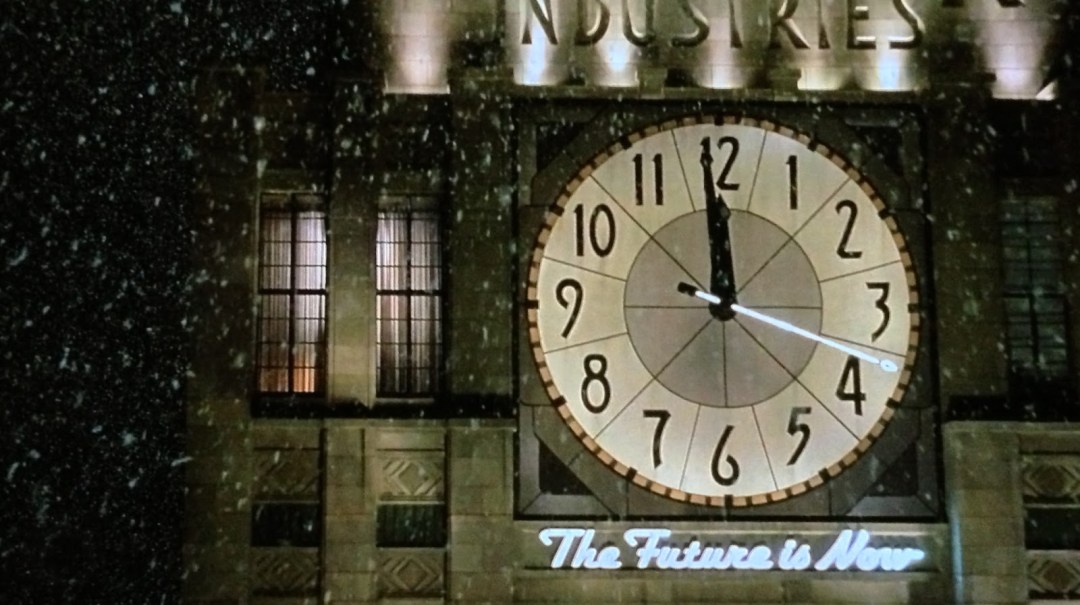
the clock on the Hudsucker building in the snow in The Hudsucker Proxy, with the words "The Future is Now"

In Defense of The Hudsucker Proxy

Joel and Ethan Coen make two types of films. Both types are comedies.

The first type sometimes gets mistaken for a drama. They’re the dark comedies that usually operate within a specific genre. Some of these are easily spotted – even Wikipedia calls Fargo a comedy – but it’s easy to get distracted by how serious they look on the surface. The Man Who Wasn’t There is a black-and-white period noir, which somehow overrides that the whole film is set in motion by someone coming up with this totally crazy idea he’s calling “dry cleaning”. The closest to a true drama that the Coens have directed is probably No Country for Old Men, but it has a huge amount of funny hair for a very serious, tense movie.

Continue reading “In Defense of The Hudsucker Proxy”