2019 in Film(s That Didn’t Come Out in 2019)

Check out previous installments here and here.


There’s a huge pressure on anyone who wants to talk or write seriously about film to pretend as if they’ve already seen every great film ever made, even as dozens more great, must-see films appear every year. It’s always been there, obviously, but it’s been magnified – like so many futile anxieties – in the age of social media, where showing off your esoteric knowledge of the medium can sometimes seem more like the film nerd version of an Instagram flex than a sincere celebration of film and its history. It creates a paralysing urgency around over a hundred years of art and it’s tempting to throw up your arms and give up. Where do you even start? Just let Disney make the choice for you and shovel whatever focus-tested crap they’re releasing next into your waiting mouth.

That pressure can be exhausting at times, but it’s an argument for logging off, not giving up. We already loved film when we started this blog and we’ve only fallen deeper and deeper in love over the past few years. It’s hard to overstate how much it has meant to us, how much it has enriched our lives to explore this beautiful art form, as practiced across the world over a century of human endeavour.

Beauty is one of the things that makes life worth living and, despite all indications to the contrary, there is an abundance of it. That’s the joy of accepting you’ll never see every great film ever made: there will always be more great films that you’ll get to see for the first time.

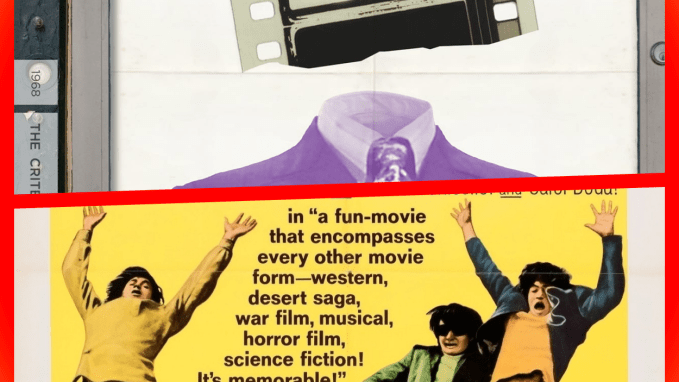
In February, we’ll go through our favourite new releases of the year when we post the fourth annual Sundae Film Awards. But looking back on the year in film shouldn’t just mean looking back at what came out this year. 2019 is the year Ciara finally saw Alien, gasped and giggled through her first Jackie Chan movie and got into borrowing DVDs from the library, the year Dean found Tarkovsky on All4, had his heart exploded by Point Break and watched Lillian Gish basically invent screen acting in Way Down East. So here are some of the best films we saw in 2019 that didn’t come out in 2019.

It’s no big deal if you haven’t seen them, but we definitely recommend checking them out.

Continue reading “2019 in Film(s That Didn’t Come Out in 2019)”

Have You Considered Shooting Franklin Roosevelt?

BOOTH: You know, you really ought to do something about that stomach. ​

ZANGARA: I do everything about this stomach!

BOOTH: Oh, yes?

ZANGARA: I give up wine, no good. I give up smokes, no good. I quit my work, no good. I move Miami, no good. I take appendix out, no good. Nothing no good. Nothing, nothing, nothing!

BOOTH: Have you considered shooting Franklin Roosevelt?

ZANGARA: You think that help?

BOOTH: It couldn’t hurt.

In the aftermath of the 2016 US presidential election, lots of people wrote lots of thinkpieces about lots of different art that could putatively “explain” This Age of Trump, This Age of Brexit, whether through its content (e.g. Idiocracy) or the cultural discourse surrounding it (e.g. the truly wild amount of controversy and debate about the Ghostbusters remake). I understand the impulse, even if I find it misguided and sad. People want a piece of media to unlock everything because it creates the illusion that you can understand and control things that are either inexplicable or which require you to re-evaluate yourself and your life in a way that’s uncomfortable or even painful. It’s not really that different from why people become conspiracy theorists, though art is usually a less dangerous lens through which to seek clarity. The main musical afflicted with this unfair burden was Hamilton, which was held up as either a celebration of bipartisan procedural democracy or a rebuke to rising xenophobia, depending on what was convenient. But some other musicals got the same treatment, including Evita and Assassins. (Not The Fix though, because no one gives a shit about The Fix.)

Assassins¹ is a very strange musical, even for Stephen Sondheim, one of the form’s most idiosyncratic writers. (He wrote the music and lyrics; John Weidman wrote the book.) It concerns some of the various men and women (mostly men) who assassinated or attempted to assassinate Presidents of the United States, with a particular focus on those who succeeded: John Wilkes Booth, Charles J. Guiteau, Leon Czolgosz and Lee Harvey Oswald. You could say it has a non-linear plot, since it presents the assassinations out of order, but that understates the oddness of its narrative structure.

Between assassinations, all the characters hang out in a kind of purgatory that exists before, after and alongside their lives. John Wilkes Booth, who died in 1865, gives Giuseppe Zangara the idea to shoot FDR in 1933. John Hinckley, Jr. and Squeaky Fromme sing a duet about their plans to kill Ronald Reagan and Gerald Ford respectively. Like Into the Woods, another Sondheim musical, it has an omniscient narrator who comes into conflict with the characters and is eventually destroyed by them. It’s very weird, very dark and very, very funny. It’s one of my favourite musicals of all time.

I don’t think Assassins can explain the current political moment. I don’t think any work of art can, because art just isn’t very good at providing answers like that. But art is excellent at asking questions or reframing how we think. Not much leaves me thinking quite like Assassins does.

Continue reading “Have You Considered Shooting Franklin Roosevelt?”

Bad Lieutenant and the Cacophony of God

Bad Lieutenant is ninety-six minutes because there’s no way you could stand it being any longer. It’s a horrible film, and frequently hard to watch. It’s not a descent into hell; descents have forward momentum. If you’re descending into hell you can envision ascending out if it. But in Bad Lieutenant, you’re already in hell. You’re so trapped that you wonder if hell is all that’s ever existed.

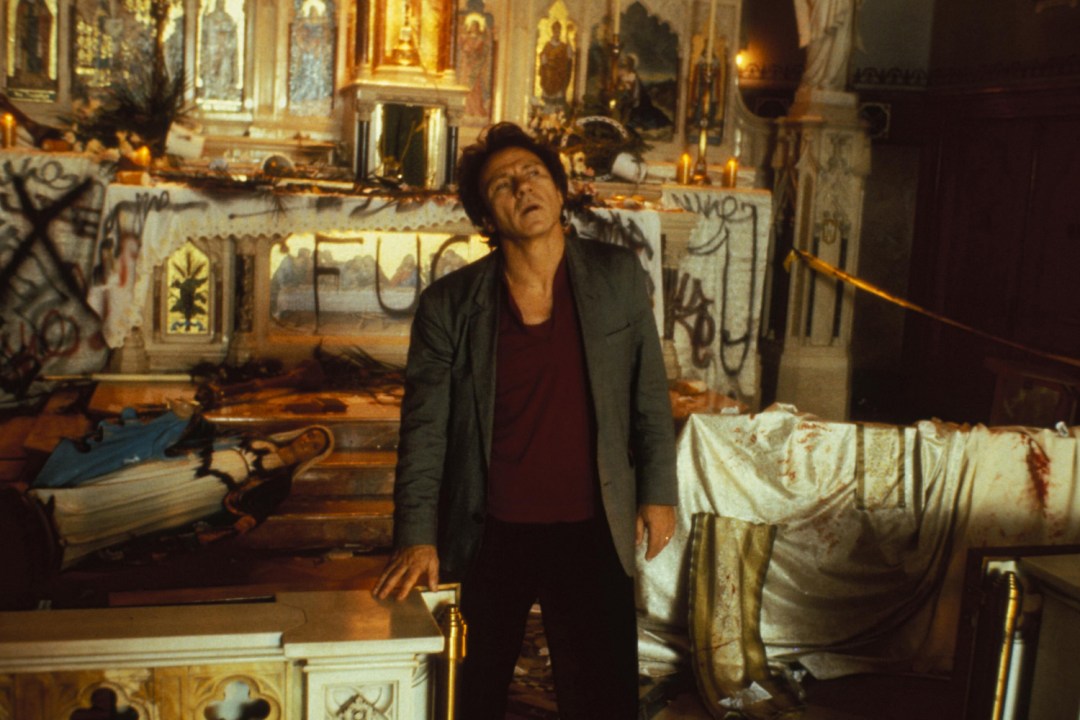
If I described the plot of Bad Lieutenant, it sounds like classic noir. Not completely – the sin and vice that would have been left implicit is rendered in full detail – but almost. Harvey Keitel plays the (unnamed) bad lieutenant, all hard liquor and harder drugs, and a hardened exterior unaffected by the crimes he investigates. He’s the cynical antihero, alienated, disaffected and corrupt. He’s hardboiled. He makes bets on a baseball match at the scene of a double murder.

Then a nun is gang-raped on the altar. The sequence is lit in red, like the fires of hell, and we see Christ on the cross, his screams of agony mixing with the young nun’s. The bad lieutenant is on the case. You imagine that he’ll devote himself to solving it, maybe going too far and bending the rules, stumbling towards some kind of redemption. That’s the plot Bad Lieutenant sets up, but doesn’t set in motion. It’s driven by the bad lieutenant himself – pulled in strange, painful directions – and he’s not a good enough person to be that kind of bad cop. He is, as Desson Howe described him in the Washington Post, just “a notch nicer than Satan.”

Continue reading “Bad Lieutenant and the Cacophony of God”

Notes on Bully

This article is part of the Notes on Failure series, which discusses interesting cinematic failures. Previously, Mallrats.


I watched Bully because Roger Ebert said it “calls the bluff of movies that pretend to be about murder but are really about entertainment”. It’s based on the real murder of Bobby Kent in 1993 by people he’d bullied and raped, and others who were along for the ride. Ebert goes on: “His film has all the sadness and shabbiness, all the mess and cruelty and thoughtless stupidity of the real thing… this is not about the evil sadist and the release of revenge; it’s about how a group of kids will do something no single member is capable of. And about the moral void these kids inhabit.”

His description of the film immediately brought to mind American Animals, one of the best films of this decade. It isn’t about murder, but it is about a violent crime, committed by young people who are propelled forward as much by the interpersonal dynamics of their group as their stated motives. It takes the violence its characters commit extremely seriously, setting you up to expect stylised film violence and then dropping you suddenly and horribly in something upsettingly realistic. I didn’t go into Bully hoping it would be the same as American Animals, but I like seeing how different films – and filmmakers – handle similar subject matter and themes.

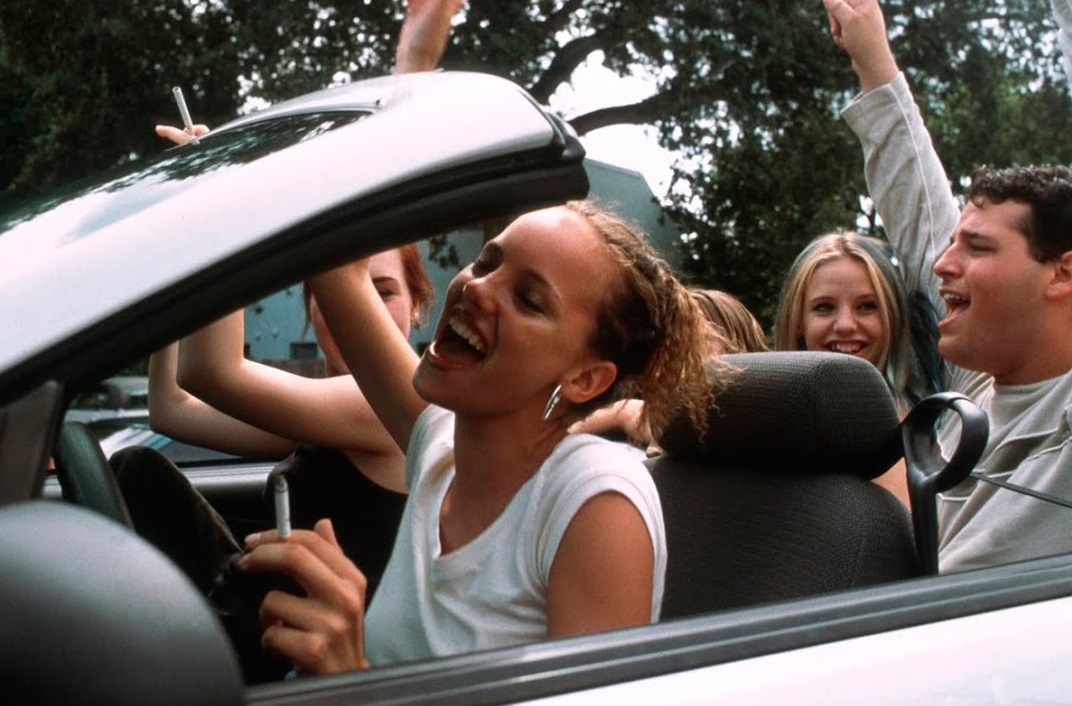
Bully is a great film in almost every way. The cast are phenomenal, especially Rachel Miner and Brad Renfro as Lisa and Marty, the ringleaders of the murder. The camera stalks moodily through Florida suburbs perched precariously on the edge of the Everglades, everything cast in light and shadow by the harsh streetlamps. You can almost hear the ambient buzz of electricity through overhead wires. The screenplay avoids the pitfalls of many realistic treatments of teen life written by adults. It isn’t full of outdated slang. The teenagers sound like teenagers, especially in all the ways teenagers try not to sound like teenagers. It’s a great film. Almost.

The co-writer of that screenplay, David McKenna, disowned the finished film, writing in a furious letter to the director and producers that it “resembled a porno” with “unbelievably gratuitous sex, no story, zero motivation [and] no character development”. He is credited as Zachary Long in the finished film. I don’t agree with McKenna or others who gave Bully harshly negative reviews, like David Edelstein. But I also don’t agree with Roger Ebert, who said it was basically perfect.

It’s not perfect. It’s almost perfect. But it’s too goddamn creepy to get there.

Continue reading “Notes on Bully”

The Problem with Your Netflix Recommendations

I despise The Big Bang Theory to an almost pathological degree. According to Netflix, The Big Bang Theory is an 88% match to my interests. By contrast, Blackadder is just a 71% match, even though it’s a show I’ve watched and loved my entire life. Breaking Bad, which I’ve watched from start to finish multiple times on Netflix, has a healthy 96% rating. But Brooklyn Nine-Nine, which I used to watch on Netflix until it got crap and I stopped three and a half years ago, has an even healthier 97%. Hannibal, another show I’ve watched from start to finish on Netflix, clocks in at 84%, narrowly ahead of Peppa Pig at 82%. Comedians in Cars Getting Coffee, a show I would only watch if paid a princely sum to review, is a 90% match to my interests. Only Fools and Horses, a show I watch all the time, is rated too low for Netflix to even bother giving me a number. My recommendations are full of anime, even though I haven’t watched any anime since I was a child. Netflix thinks I’d like every single Louis Theroux series it has, even though I have never, ever watched any documentary TV series in my life.

Netflix’s recommendation algorithm seems like it’s broken. But it’s not, it’s working just fine, at least for now. The problem is the algorithm’s job isn’t to help users find TV shows and movies they would enjoy. It’s to trick Netflix’s investors into thinking the company is worth more than it is.

Continue reading “The Problem with Your Netflix Recommendations”

You Should Watch Ishtar

I am a big fan of Wikipedia’s List of Films Considered The Worst. A big part of that is finding “list of films considered the worst” an amusing phrase, but the other part is that it’s fascinating as an alternate path through the history of cinema. It’s so easy to think of film history through the lens of what’s successful – the rise of auteur directors in Hollywood in the late 1960s giving way to blockbusters after the popularity of Jaws and Star Wars, for example – that Wikipedia’s List of Films Considered The Worst feels like getting to see everything from a new angle. It’s got everything from B-movie trash and weird vanity projects to big-budget Hollywood flops and failed sequels that contradict everything in the preceding movie.

Some of the films on it, I’m sure, are unwatchable. Many are merely mediocre. But at least a few are misunderstood, unfairly maligned masterpieces. I am excited to watch pretty much any film on there that I’ve seen someone sincerely champion. I can’t wait to watch I Spit on Your Grave and Mommie Dearest and Showgirls. Martin Scorsese says The Exorcist II is good and I’m willing to roll those dice. The films that I love that are on that list are films that I love with all the fire in my belly, that I love all the more to make up for everyone who hated them. I think Heaven’s Gate is astonishingly beautiful and I will fight anyone who blames it for the death of director-driven Hollywood filmmaking. I think Freddy Got Fingered is a surrealist masterwork and hilarious besides.

And I fucking love Ishtar.

Continue reading “You Should Watch Ishtar”

Notes on Mallrats

This article is part of the Notes on Failure series, which discusses interesting cinematic failures. Previously, Black ’47.


Kevin Smith has had a really weird career. He’s one of the directors I’d be least surprised for someone to mention as a key influence in getting them interested in films and filmmaking, and also one of the directors I’d be least surprised to hear mentioned in pure contempt, no explanation necessary. He seems to be more known as a generic pop culture figure of the internet at this point: he’s responsible for the worst tweet of all time, which I’m sure more people have seen than saw Tusk. He has like a hundred podcasts and mostly makes films based on episodes of those podcasts now? I don’t even know. I couldn’t watch the trailer for Yoga Hosers through to the end, but I’ll still probably go see Jay and Silent Bob Reboot in the cinema.

I like Kevin Smith a lot more than people who hate Kevin Smith. I like a lot of his early films. I think Clerks is a masterpiece. I love Dogma, a film that is legitimately important to me as an… idiosyncratic Catholic. I think Chasing Amy has become sort of misunderstood because its logline – lesbian falls in love with a man – seems pretty gross in 2019, even though watching the film, it is made clear that she was bisexual the whole time, as is every other character. I never rewatch Clerks II because I would rather just watch Clerks, but it’s legitimately pretty good, and I would watch Jeff Anderson play Randal in anything.

But then there’s Mallrats. Smith’s second film – about a bunch of goofy misadventures of some twenty-somethings in a mall – was a critical and commercial flop on release, but it became a cult hit on home video. In the VHS episode of Harris Bomberguy and Shannon Strucci’s Scanline series, Bomberguy talks about how the aesthetic differences between watching a film in a cinema vs. watching it on a television work in favour of Mallrats, as it becomes something much lower-stakes, a backdrop to you and your friends doing something else that pulls you in at the funnier parts rather than something blasted at you from all angles like it’s the most important thing in the world. “The joy of [Kevin Smith films] is in crowding round a small TV at your friend’s house and watching little people on it with no pretensions of grandiosity,” he says.

But unfortunately, even in the lowest-stakes environments – from a VHS at your friend’s house to on your laptop while you scroll through your phone – Mallrats still sucks. Continue reading “Notes on Mallrats”

What Disney Will Destroy Next

We don’t much like giant media conglomerates around here – they make art inaccessible to the poor and abuse the copyright system to steal from the entire human race. But if I could smash just one of the huge corporations that dominate the entertainment industry, it would be Disney, no question. The Walt Disney Company is now the second-largest media conglomerate in the world following its acquisition of Fox, just behind AT&T. It is by far the largest film company in the world, collecting over a third of the global box office this year alone. And it’s a terrible, evil company that can’t be trusted with the power it’s acquired.

The merger’s first victims – after the thousands of people who lost their jobs because of it – were independent cinemas. Disney has a unique policy about who can screen its new and old films. It divides theatres into commercial theatres (which can show new Disney films, but not old ones) and repertory theatres (which can show old Disney films, but not new ones). Most independent theatres don’t fit this binary, of course. Many will screen some new releases so their foot traffic can subsidise smaller films or releases. After the merger, Disney extended this policy to the 20th Century Fox back catalogue, with disastrous implications for independent theatres. Disney is arbitrarily ruling theatres commercial or repertory, often without communicating this fact to their management, so they only learn when an attempted booking goes nowhere. The Fox catalogue contains loads of classic films whose well-attended rereleases are the financial backbone of many independent theatres: Young Frankenstein, Alien, Raising Arizona, Butch Cassidy and the Sundance Kid, Die Hard. Without them, independent cinemas will struggle to survive. (There is a purported exemption for The Rocky Horror Picture Show, for unexplained reasons.)

But it won’t stop there. Disney doesn’t care about the collateral damage of its endless pursuit of profit for its own sake. The people who run it are perfectly willing to lay waste to anyone who delays them even one second on their way to the next billion dollars. Disney will only grow more and more powerful unless it’s broken up by state action.

Until then, here’s some other things Disney will destroy.

Continue reading “What Disney Will Destroy Next”