The Redistribution of Art

If you read a lot of pop culture criticism, you’ll very quickly come across three words: vital, essential and necessary. Critics, especially film and TV critics in my experience, love to describe the very best art in the same way most people describe things like food, shelter and healthcare. The instinct might be to treat this as hyperbole, but I like to take people at their word, and besides, there’s no shortage of writing out there that makes explicit what’s merely suggested in most uses of “vital”, “essential” and “necessary”. Moreover, I agree completely: art is an essential part of life.

There are as many explanations for why art is vital, essential and necessary as there are thinkpieces explaining why. Art is how we understand each other when we can’t see inside each other’s skull prisons. Art has profound social value, capable of transforming how people see the world by forcing them to confront unfamiliar realities or new perspectives on age-old issues. Art and the appreciation of art is what makes life meaningful at all for lots of people. I don’t disagree with any of those points of view, but they’re all a bit piecemeal for my taste, failing to provide a universal justification for why art is necessary.
Continue reading “The Redistribution of Art”

Oliver in the High Castle: Nazis in Pop Culture

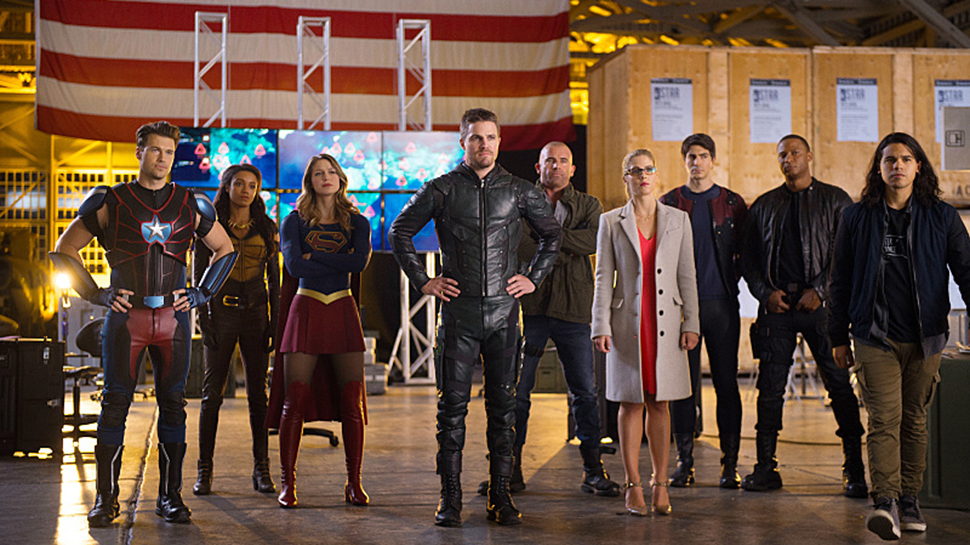
The fourth annual Arrowverse crossover event – bringing together characters from The CW’s Arrow, The Flash, Legends of Tomorrow and Supergirl – was called “Crisis on Earth-X” and I…enjoyed it? I’ve written previously about my visceral hatred for superhero TV show crossovers, and “Crisis on Earth-X” certainly doesn’t avoid all the problems of the genre, but, as a self-contained story – as a TV movie, essentially – it’s certainly the most successful Arrowverse crossover yet.

It was about Nazis.

Continue reading “Oliver in the High Castle: Nazis in Pop Culture”

The Problem with Netflix Originals

Netflix is a very successful business, and I don’t know the first thing about business, so far be it from me to tell them what they should do. (I know so little about business that I can’t understand why owning a company that has never made a profit has made Jeff Bezos, the Amazon guy, the richest person on the planet.) But I do co-run this blog about pop culture, and Netflix has been one of the most important and transformative forces in film and TV (mostly TV) in recent years. The effects of that have been a mixed bag, but it’s hard to deny their sheer scale.

This kind of scares me, because Netflix’s share price does not seem at all proportionate to its profits, and while I don’t know anything about business I have seen Enron: The Smartest Guys in the Room, so a part of me is convinced that Netflix will suddenly and unceremoniously collapse one day. Which, aside from anything else, means all the art made exclusively for Netflix might just… disappear? The archival implications of the streaming model are pretty terrifying if you think about it for more than a minute, which is why I’m one of the few people my age that spends her money buying second-hand DVDs.

But, like I said, I don’t know the first thing about business, so that might be nonsense, and my DVD collection might be no different from stockpiling tins of food in a bunker in case the Cold War turned nuclear. But I do think I know a small bit about film and TV, and film and TV is Netflix’s business. So, on that basis I would like to make this humble suggestion to Netflix HQ: stop making so much fucking original content.

Continue reading “The Problem with Netflix Originals”

The Anxious Christianity of Scott Derrickson

Scott Derrickson is a frustrating filmmaker. Since his 2005 breakthrough with The Exorcism of Emily Rose, he’s had a string of commercial successes, some of which were even good movies. There was his terrible remake of The Day the Earth Stood Still, his excellent horror film Sinister and his addition to the Marvel Cinematic Universe, Doctor Strange, which, like most Marvel movies, was good, but not particularly so.

On paper, there are a lot of directors like Scott Derrickson: variably good, but consistently profitable, making films that millions of people see, but almost none of those people know their name. Horror and comedy are full of these directors. Sure, tens of millions of people saw Annabelle: Creation and Central Intelligence, but who amongst us can really say we know who made them? Usually, I’m dimly aware of these financially-successful mid-tier directors and don’t super care about them. But I make an exception for Scott Derrickson. That’s partly because his best films are sincerely great, but mostly it’s because he’s one of the few successful and influential Christian directors working in mainstream cinema.

Continue reading “The Anxious Christianity of Scott Derrickson”

Some Unspoken Thing: In Praise of Guardians of the Galaxy Vol. 2

For at least a decade, we’ve lived through a pretty unprecedented boom in superhero films. Disney releases three Marvel Cinematic Universe films a year, Warner Brothers is trying desperately to make the limping DC universe hold together, Fox has the X-Men, and that’s not counting failed experiments like Fantastic Four or Sony’s Spider-Man universe, which, as far as I understand, they’re attempting to still do, but without Spider-Man. Superheroes aren’t suddenly popular out of nowhere or anything, but the sheer glut of superhero movies being produced now makes the progenitors of the superhero boom – like Christopher Nolan’s Batman trilogy or Sam Raimi’s Spider-Man – look modest by comparison.

It’s no secret that I’ve been critical of the superhero boom. I would support a ten-year ban on producing superhero films if such a thing were possible. But that isn’t out of snobbiness, or even out of a dislike of superhero films. I think Spider-Man 2 is a masterpiece. I saw The Dark Knight Rises in the cinema twice and think anyone who criticises its many plotholes is a pedantic killjoy. I think Logan had one of the best screenplays of last year. But the superhero boom is a feature of a much bigger problem: a trend in blockbuster filmmaking, and popular cinema in general, away from the thoughtful, interesting and weird and towards bland, hollow pleasures. It started with superheroes, and now it’s creeping all over the place, from Star Wars to the Universal monsters.

Superhero films tend to get a disproportionate amount of praise because they’ve spent a decade wearing us down, calibrating our expectations to just the right frequencies. I hate the word “overrated,” but I don’t think there’s a better word to explain the phenomenon of every Marvel release apparently being one of the best films ever made, if Rotten Tomatoes scores are anything to go by (and they aren’t). I really liked Wonder Woman, even if it had third act problems, but when people started talking about it as one of the best films of the year and it being “snubbed” by the Oscars, I felt like I was going insane. So I’ve never felt the need to speak up for a superhero film, really.

But then there’s Guardians of the Galaxy Vol. 2.

Continue reading “Some Unspoken Thing: In Praise of Guardians of the Galaxy Vol. 2”

The Sundae Film Awards 2018

It’s been an extraordinarily long Oscar season, seeming to last from summer to March, with even a smattering of awards contenders coming out before that. It’s also been a particularly good year for films – which is awkward to define if you don’t live in America. We’ve decided it means “films that came out in 2017 in Ireland unless they were eligible for the Oscars last year as well as films that came out in 2018 in Ireland if they were eligible for this year’s Oscars.”

We can’t really claim that these are what we think should have been nominated at the Oscars, or should win, since we can’t even be sure if any film that wasn’t nominated was eligible. But if we were the only two members of the Academy, and we only cared about the eight major awards – we care about most of the others (except for the fake awards like Best Original Song) but this post would be absurdly long if we picked those too – this is what you’d get: the Sundae Film Awards 2018.

We each did out our personal nominees and then selected the winner by consensus, so the winners only come from films that both of us have seen and nominated, but we’ve each picked a personal runner-up regardless of whether the other has seen or nominated it. We also each picked a Special Achievement Award for something not covered in the major categories. You can see each of our full slates of nominees at the bottom of this post, which we encourage you to check out if you’re looking for recommendations, because there really were a lot of fantastic films this year.

Continue reading “The Sundae Film Awards 2018”

Art and the Artist

If you read a lot of pop criticism and entertainment journalism, you’ll be a familiar with a debate about “separating the art from the artist” or some similar turn of phrase. This is a very old debate, but it’s come to occupy ever more space in discussions about art, especially popular art, in recent years. The main driving force behind its increasing prominence has been the proliferation of online publications covering entertainment news and producing reviews and criticism over the last ten or so years. Such platforms are making more information and commentary on the entertainment industry and more opinions about art available to more people than ever before. Over the years, plenty of people who make art have been exposed for doing bad things, and so naturally the issue of how we should relate to art made by bad people has come up pretty regularly in these publications.

But that was before Jodi Kantor and Megan Twohey (for the New York Times) and Ronan Farrow (for the New Yorker) exposed Hollywood mega-producer Harvey Weinstein as a serial sexual predator. I don’t know why this one was the tipping point, but in the months since, dozens of other sexual predators working in the entertainment industry, in news media and in sports have been similarly exposed. In fact, there’s been a seemingly endless wave of revelations about powerful public figures – almost exclusively men, to no great shock – who have abused their power in order to sexually harass and assault other people, including minors.

What used to be a largely seasonal phenomenon of finding out a celebrity was a bad person, getting bombarded with thinkpieces about it and then forgetting about it when something else came along to make you anxious about the world has now become an apparently permanent state of revelation.

Continue reading “Art and the Artist”

Sofia Coppola’s Sad Rich People

In 2003, Sofia Coppola released Lost in Translation. It was critically acclaimed, grossed 119 million dollars on a budget of four million, and made Coppola the first American woman ever nominated for Best Director at the Oscars. It’s about two Americans – Bill Murray and Scarlett Johansson – in a luxury hotel in Japan, two lonely people who find some solace in each other, an almost-romcom where nothing happens and everyone wants to die. It’s a beautiful film – I often say that subtlety is overrated, but Lost in Translation is quiet and soft, a reminder that a film can be those things without for a moment being boring or pretentious.

It’s 2004, and Sofia Coppola might become one of the most important film directors of her generation. Not because she’ll be tokenised as a woman, and not because her dad made The Godfather, but because of her incredible talent.

It’s fourteen years later, and it hasn’t really worked out that way.

Continue reading “Sofia Coppola’s Sad Rich People”

Notes on Split

I went to see Split on my twenty-third birthday, and I was very excited. That was partly because my birthday was the day Donald Trump was inaugurated as President and it was a way to not think about, you know, events. But it was mostly because I am an M. Night Shyamalan apologist, and he was back! I love The Sixth Sense and Unbreakable and The Happening, and after a string of bad decisions, he was resurgent. He’d had a surprise hit on television with Wayward Pines and his previous film, The Visit, had been both well-received and profitable. Now it was time for his redemption story to go mainstream with his biggest success since Signs.

And it did.

Measured by return on investment, Split was Shyamalan’s most profitable movie, turning $9 million into over $250 million, and it received some of the best reviews of his career. It was number one at the US box office for three consecutive weeks (a record in Shyamalan’s filmography matched only by The Sixth Sense), it had a sequel greenlit by April, and James McAvoy is one of the year’s prototypical examples of an actor locked out of the Oscars race by genre rather than merit. M. Night Shyamalan brought his reputation back from the dead with one of the year’s most successful movies.

And I hated it.

Continue reading “Notes on Split”

Because I Choose To: The Horror and Hope of Free Will

The final battle between good and evil at the end of The Matrix Revolutions is the best part of a very flawed movie. Whatever else the Matrix sequels did wrong – and they did a fair bit – the last fight between Neo and Agent Smith is basically perfect. It’s not just a punching contest, it’s a distillation of every moral value at stake in their conflict. I know that’s a controversial statement because I’ve seen so many people make fun of the best part of the scene:

Agent Smith: “Why, Mr. Anderson? Why, why, why? Why do you do it? Why? Why get up? Why keep fighting? Do you believe you’re fighting for something? For more than your survival? Can you tell me what it is? Do you even know? Is it freedom or truth? Perhaps peace? Could it be for love? Illusions, Mr. Anderson, vagaries of perception! Temporary constructs of a feeble human intellect trying desperately to justify an existence that is without meaning or purpose. And all of them as artificial as the Matrix itself, although only a human mind could invent something as insipid as love. You must be able to see it, Mr. Anderson. You must know it by now! You can’t win! It’s pointless to keep fighting! Why, Mr. Anderson?! Why?! WHY DO YOU PERSIST?!”

Neo: “Because I choose to.”

I worry about what it means that such a beautiful and simple encapsulation of what it means to be a human being is so routinely mocked for its alleged meaninglessness: “Because I choose to”. There is something in our language, always present, but more and more prevalent as we sink deeper into the grey muck of modernity: we don’t know how to talk about freedom. We don’t know how to speak about each other as beings with free will. We speak of people driven by rage, rather than people who choose the path of rage. We speak of people who can’t help but be who they are and do what they do, rather than people who consistently choose to continue in their habits. We speak of people as if they’re machines, rather than people.

Some of it is well-intentioned, I’m sure. There are legitimate critiques of theories of freedom that ignore the ways we are prevented from exercising our free will. But we’re at risk of sprinting towards the other extreme. We’re at risk of denying that free will exists at all.

Continue reading “Because I Choose To: The Horror and Hope of Free Will”