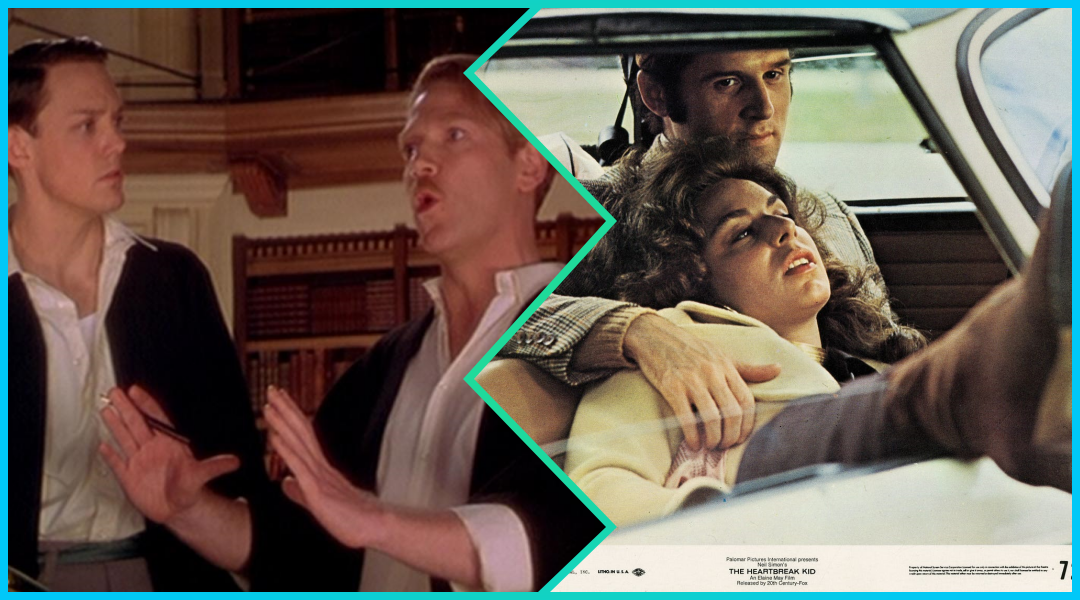
Friday Film Showcased, Episode 1: The Heartbreak Kid (1972) | Love’s Labour’s Lost (2000)

A brand new podcast, hot and fresh out the kitchen, hosted by Ciara Moloney and Conor Hogan.

For many years, with regard to their film-watching, Ciara and Conor have been theming their months. For instance:

  • Elaine May May (sic) – films starring, written by, or directed by Elaine May.
  • Darling works (?) of May – William Shakespeare Films.
  • Cartoon June – you know, animated.
  • Soviet (J)Un(e)(ion) – Films from countries that were once in the USSR.

Sometimes the titles of these months are puns, sometimes alliterative. Sometimes, it is awful strained altogether (see above). But it has always been fun. Or at least I hope so. They’ve been doing it long enough!

In the inaugural (that means first) episode of FFS, Ciara and Conor discuss their May film seasons (Elaine May and William Shakespeare), and Showcase two in particular.

Spoiler: It’s the two films in the title of this episode. Watchlist:

Elaine May: https://letterboxd.com/hoganassasin/list/elaine-may-may-sic/

William Shakespeare: https://letterboxd.com/hoganassasin/list/darling-works-of-may-shakespeare-watched/

You can listen to it here:

Episode 1: The Heartbreak Kid (1972) | Love's Labour's Lost (2000) Friday Film Showcased

And you can even listen to it accompanied by the soothing sounds of a Crackling Fireplace. Relaxing!

Crackling Fireplace Edition – Episode 1: The Heartbreak Kid (1972) | Love's Labour's Lost (2000) Friday Film Showcased

Listen and subscribe on: Spotify (with fireplace) || Apple Podcasts (with fireplace) || Amazon Music (with fireplace) || Castbox (with fireplace) || Pocketcasts (with fireplace)

Mentioned in the podcast

Jeffrey Salkin article on The Heartbreak Kid: https://religionnews.com/2021/05/20/charles-grodin/

Michael Sragow on Tootsie: https://www.criterion.com/current/posts/3404-tootsie-one-great-dame

Kenneth Branagh and Love’s Labour’s Lost cast on Charlie Rose: https://charlierose.com/videos/19196

Ciara’s article in Ishtar: https://thesundae.net/2019/10/28/you-should-watch-ishtar/

Scenes from a Mall (1991): https://www.imdb.com/title/tt0102849/
You Should (Not) Watch Julien Donkey-Boy

“I don’t know how much movies should entertain. To me, I’m always interested in movies that scar.”

David Fincher, interviewed by Mark Salisbury in Empire, February 1996

The first Harmony Korine film I saw was Spring Breakers, because Dean made me watch it for our podcast, The Sundae Presents. I did not like Spring Breakers, but in a way where saying whether I liked it or not seems like such a gross simplification that it becomes a lie. While watching it, I found what was great and awful about it impossible to parse, and from a distance, I mostly think of it as an epic troll – a movie whose existence is a joke despite it containing zero jokes. I remember the boring parts more than the unpleasantness that felt so visceral at the time.

Julien Donkey-Boy has not come out in the wash that way. I can feel its viscerality still wriggling in my blood. Korine’s sophomore directional outing, Julien Donkey-Boy is the sixth Dogme 95 film – it’s got the certificate and everything – though less because it strictly follows the Dogme 95 rules (no “superficial action,” no non-diegetic sound, only natural lighting, only handheld cameras) and more because what the hell else could it be? It is, at once, a family drama and totally outside the bounds of mainstream filmmaking. And since there are Dogme 95 movies that are both these things, fuck it, this one is too.

Continue reading “You Should (Not) Watch Julien Donkey-Boy”

Martin and Lewis, Partners in Film and Life

By rights, Martin and Lewis should have the kind of cultural footprint renders them permanent household names: the status that turns artists into Halloween costumes, as archetypal as cartoon characters and ancient gods. For ten years, from 1946 to 1956, Dean Martin and Jerry Lewis were a double act, and accurately describing how popular they were sounds like gross exaggeration. They were so big that the only fitting comparisons are to rock stars—and not just any rock stars, but Elvis Presley, or The Beatles. “For ten years after World War II, Dean and I were not only the most successful show-business act in history,” Jerry Lewis wrote with his trademark humility in Dean and Me: A Love Story (1984), “—we were history.” Their live shows were pandemonium. They reportedly made eleven million dollars in 1951 alone. Their movies were box office smashes (despite lukewarm reviews). No less an authority than Orson Welles said they were so funny that you “would piss your pants.”

Martin and Lewis have never been erased from cultural history, but they have been minimized: evaded, elided, downplayed. I was well into adulthood when I even learned that Dean Martin and Jerry Lewis had spent a decade as a double act. Their separate images—Dean Martin, Rat Packer, king of cool, and Jerry Lewis, doing wacky slapstick in The Bellboy (1960) or The Nutty Professor (1963)—seem to have endured in cultural memory much more than their work together. Maybe that’s because the willingness to go back and watch old episodes of The Colgate Comedy Hour (1950–55) would be extremely niche even if the media conglomerates cared about the preservation and accessibility of 1950s TV, not to mention 1940s radio. Maybe it’s because their true brilliance was in live—often improvised—performance, and so only shadows of their greatness remain. Their films were and are often viewed as pretty haphazard affairs, cashing in on a hot thing, not unlike Elvis’s movies in the decade that followed. (Martin and Lewis’s movies share a producer with Elvis’s—Hal B. Wallis—and sometimes directors, too, particularly Norman Taurog.) But the extraordinary thing is that, even if the films are just slapdash and shadows, Martin and Lewis were so great that their films are great films anyway. Their brilliance shines through the weakest material: the ineffable, bewitching something between them—an intimacy, an immediacy, an ingenuity—frozen in amber for those of us who would never see it in the Copacabana.

After exclusively thinking about Martin and Lewis for many months, I wrote a primer on them for MUBI Notebook. Read the whole thing here.

Die Hard: The Sundae Presents Episode 33

Ciara and Dean co-host The Sundae Presents, a podcast in which they each make the other watch films they haven’t seen. In our Christmas special, Ciara makes Dean fulfil his only goal before turning 30: finally watching Die Hard. They talk about masculinity, Christmas movies, and who was offered the role before Bruce Willis.

Listen on Spotify

Listen on Google Podcasts

Listen on Apple Podcasts

Listen on Amazon Music

Listen on Audible

Listen on RadioPublic

Listen on Pocket Casts

I Know Your People, Sean

The Quiet Man is the bogeyman of Irish cinema. Shot on location in County Mayo in the west of Ireland in 1951, it’s both the most significant—and most acclaimed—screen depiction of the country before an indigenous film industry developed in the 1990s, a go-to example of stage Irish buffoonery that Irish cinema has raced away from. When An Cailín Ciúin—the first Irish language film to be nominated for an Oscar—powered itself to the Academy Awards last year, its English title framed it as a reply to John Ford’s fantasy depiction of Ireland: The Quiet Girl

Irish people lay claim to and celebrate The Quiet Man—there’s a whole museum in the village where it was filmed—but just as often, cringe away from it. We anxiously imagine that this is how Americans see us. But the truth is, The Quiet Man is a much bigger deal to us than it could ever be to them.

I wrote about The Quiet Man and John Ford’s complicated diasporic nostalgia for Bright Wall/Dark Room. You can read it here!

The Cheerfully Dystopian Americana of Hands on a Hard Body

On paper, the premise of Hands on a Hardbody: The Documentary–released twenty-five years ago this week–might sound niche: it documents a 1995 endurance competition where the last contestant to keep their hands on a Nissan Hardbody pick-up truck wins the truck. But on screen, it’s enthralling, an irresistible salted-caramel treat. It is, somehow, both giddy and grim: at once a bite-sized anthropological study of post-Reagan America and the most exciting sports movie not to feature Rocky Balboa. 

A dealership in Longview, Texas has run the Hands on a Hardbody competition for years. The twenty-four contestants are drawn from a raffle because there are so many entrants: you’re only allowed to put your name forward once per day, so prospective hopefuls come back day after day to maximise their chances of being selected. When the selected two dozen arrive on the morning of the competition, the rules are outlined. You must have one hand on the truck. You cannot lean on the truck, or squat; you have to be standing. There is a five-minute break hourly and fifteen-minute break every six hours.  The first time I watched it, I thought six hours seemed like a long time. 

I wrote about Hands on a Hard Body for Crooked Marquee. You can read it here!

The Miracle Worker Is Not The Film You Think It Is

The Miracle Worker is something of a middle school staple in the United States. Helen Keller is a significant figure in American history—she was the first deafblind person to earn a bachelor’s degree and a co-founder of the American Civil Liberties Union, among other things—and the 1962 film offers an accessible way into her story. But when something’s a middle school staple, you inevitably tend to continue viewing it through your middle school eyes, no matter how the years pass. It can take so much to let go of that—even though, if pushed, none of us would have trouble admitting that we were really stupid when we were 13. 

I’m from Ireland, where The Miracle Worker doesn’t have that kind of cultural cache, but I’ve spent enough of my life online to absorb it by osmosis. For American leftists in particular—eager to reassert Helen Keller’s socialism, since that doesn’t seem to come up in middle school—The Miracle Worker is almost a bogeyman. The more I learned about Helen Keller, the more it seemed like people talking about her life and work were actively countering The Miracle Worker, sometimes explicitly. The Miracle Worker is the official Helen Keller story, sanitized and shrink-wrapped for moral majority suburbanites, a reduction of a complex, trailblazing woman. For disability activists, it’s invoked the way Rain Man is by autistics: this is how they see us, this is what we are understood to be

I wrote about the 1962 Helen Keller biopic The Miracle Worker for Current Affairs. You can read it here!

Notes on Where The Truth Lies

This article is part of the Notes on Failure series, which discusses interesting cinematic failures. Previously, The Conjuring.

As I threatened to at the end of last year, I have gotten way into Martin and Lewis. I have watched all their movies and a bunch of Colgate Comedy Hour, and read Dean & Me: A Love Story, Jerry Lewis’s memoir about his partnership with Dean Martin. I have bored the pants off people by subjecting them to irrelevant Martin and Lewis anecdotes.

So, naturally, I carved out a couple of hours to watch Where the Truth Lies. Adapted from a novel by Rupert Holmes (of ‘Escape (The Piña Colada Song)’ fame), it’s a queer fictional take on Martin and Lewis’s break-up – a ‘90s erotic thriller half a decade late. By rights I should love it no matter how bad it is. But Where the Truth Lies is not just bad, it’s baffling. Top to bottom, it’s full of insane decisions at basically every level of filmmaking.  

Here’s why:

Continue reading “Notes on Where The Truth Lies”

Come and Have a Go, If You Think You’re Clever Enough

Television criticism, maybe even more so than other forms of arts criticism, has an implicit but rigid hierarchy. “Often, these biases involve class, gender, race, and sexuality, disguised as biases about aesthetics,” Emily Nussbaum writes in her book I Like to Watch: “Green/grey drama, serious; neon-pink musical, guilty pleasure. Single-cam sitcom, upscale; multi-cam, working class.” Nussbaum attributes this, in part, to television’s status anxiety: it wasn’t too long ago that TV was considered the idiot box, the boob tube, a vast wasteland. “So much of TV,” John Mason Brown told Steven H. Scheur in 1955, “seems to be chewing gum for the eyes.” For the rest of the twentieth century, at least, most people would agree with him. And so critics appeal all too readily to other, more respectable mediums – it’s a visual novel, a ten-hour movie. It’s not TV, it’s HBO.

I agree totally with Nussbaum’s argument, and have made versions of it myself over the years. But the privileging of drama over sitcoms, of gritty realism over silly genre fare, of masculinity over femininity, is a relatively small part of the equation. The types of television most neglected by critics are, if we’re honest, the same ones that make up most of the TV made and most of the TV watched: all the vast, vast area that exists outside of scripted comedy and drama programmes.

Continue reading “Come and Have a Go, If You Think You’re Clever Enough”