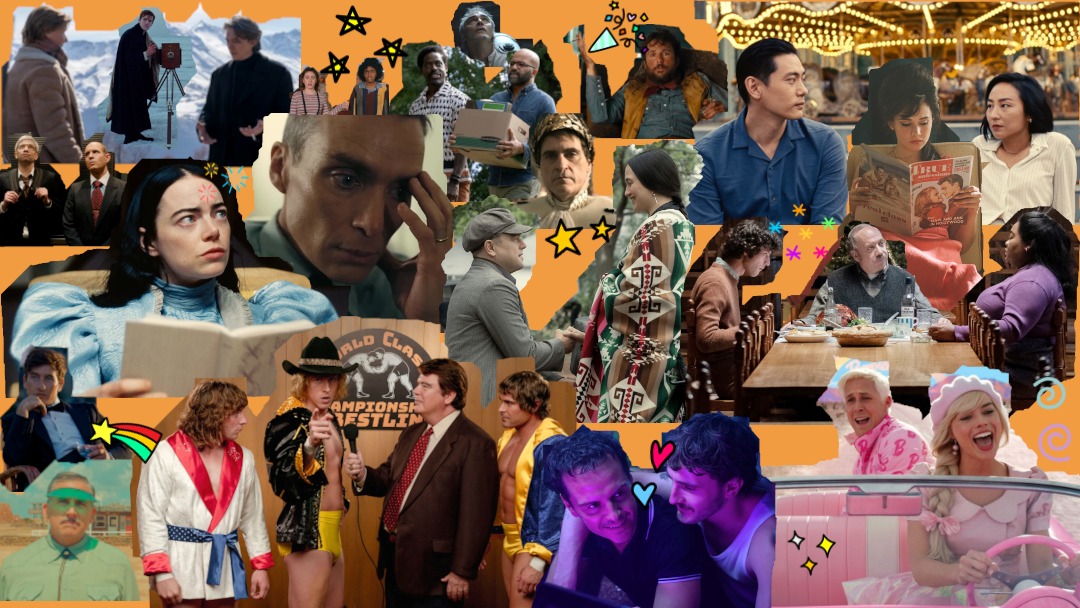
The best and worst thing about 2023 was how it gave us genuine hope that maybe… the movies are back? The seemingly unbreakable stranglehold that effects-driven action blockbusters have had on popular cinema for our entire adult lives was shattered by, of all things, an existentialist Barbie movie and a J. Robert Oppenheimer biopic. (The latter also dethroned the repugnant Bohemian Rhapsody as highest-grossing biopic of all time, a victory for good taste we never thought would happen in our lifetime.) Disney lost the global box office for the first time since we started this blog, and the Oscar nominations were so good people had to make up reasons to be mad at them. There were so many great films that picking winners for these awards wasn’t just difficult, it felt faintly insane. Films that might have swept other years barely got a look in. Even our full slates of nominees, linked at the bottom of the post, represent just a fraction of the greatness on offer.
Nevertheless, we did, eventually, painfully, manage to pick our winners. As with every year, we gave one award for each of the eight major Oscars: we care about most of the others (except for the fake awards like Best Original Song) but this post would be absurdly long if we picked those too. We each did out our personal nominees and then selected the winner by consensus, so the winners only come from films that both of us have seen and nominated, but we’ve each picked a personal runner-up regardless of whether the other has seen or nominated it. We also each gave a Special Achievement Award for something that doesn’t fit our other categories.
BEST PICTURE – Killers of the Flower Moon

Ciara: “What an extraordinary blessing for Martin Scorsese to, in his old age, still be producing work like this. What an extraordinary blessing for Martin Scorsese to, in his old age, be producing work that disturbs and confronts and feels truly revelatory.
Killers of the Flower Moon tells the story of a plot to murder members of the Osage nation in 1920s Oklahoma. It is, in some technical sense, a western, and a mystery, but it doesn’t have the exuberant appeal of a genre movie. It ends with a self-indictment for any such impulse. It is, instead, relentlessly devastating. There’s a couple of laughs – oh my god, has there ever been a character on screen as thoroughly dumb as Ernest (Leonardo DiCaprio)? – but the cumulative effect left me hollowed out. Robert De Niro, ringleader of the murders, feels like the devil himself, but all the more horrifying because he is human. I was reminded of Cheyenne Autumn, John Ford’s unflinching, late-career evisceration of the genocide America was founded upon. But where Ford’s filmography was always building towards that, Killers of the Flower Moon blindsided me.
Two of the most common threads in Scorsese’s work are: 1. Films about gangsters that critique American capitalism (GoodFellas, Casino, The Wolf of Wall Street), 2. Films about colonial oppression, usually in a religious context (Last Temptation, Kundun, and inaugural winner of the Sundae Award for Best Picture, Silence). In Killers of the Flower Moon, these two threads are revealed to be inextricable parts of the same story.”
Ciara’s Runner-Up: The Holdovers – “Few movies this year delighted me as much as The Holdovers. This is, in part, because Alexander Payne made The Holdovers for me. It feels like a film I would have watched on TCM when I was teenager and fallen in love with. It is such a mam movie that I am very excited to show it to my actual mam. It’s a 1970s Christmas comedy-drama like Hal Ashby might have made, anchored in three brilliant performances from Paul Giamatti, Da’Vine Joy Randolph and, in his film debut, Dominic Sessa.”
Dean’s Runner-Up: Asteroid City – “I was hooked on Asteroid City from the moment it started, and completely mesmerised the second it shifted from black and white to vibrant, sunburnt colour unlike anything I’ve ever seen before. A dizzying metatextual ode to the art of storytelling, a gutwrenching rumination on grief, and a deadpan gag-a-minute laugh riot, all at once and so much more besides.”
—
BEST DIRECTOR – Christopher Nolan for Oppenheimer
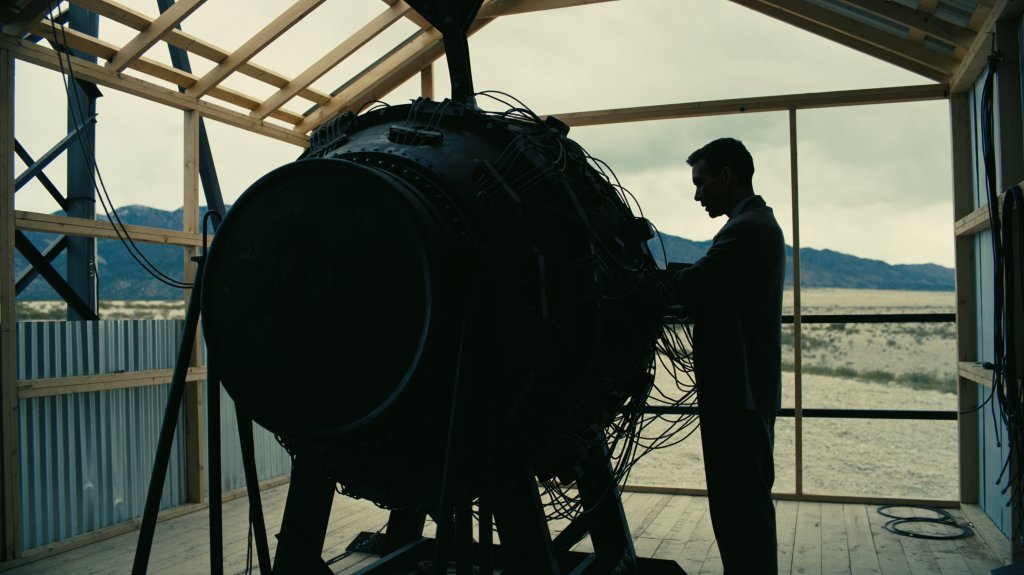
Dean: “I’m not old enough to be a true OG Nolan head, but he’s been one of my favourite directors for as long as I’ve loved film. Longer, really. I don’t know that I’d love cinema at all in a world where I didn’t love Christopher Nolan first. And yet, I’d kind of cooled on him in recent years. I like all four films he made between Inception and Oppenheimer, but none of them grabbed me by the heart and throat like the formative films of my adolescence. I respected him no less, and really admired his experimentation in Dunkirk and especially Tenet, but I thought maybe I’d kind of moved past him. A first love, sure, but not a forever one.
Oh, me of little faith.
Oppenheimer is far and away the best film Christopher Nolan has ever made, a culmination and synthesis of everything that came before. I’d forgotten how much I adore his dry comedic rhythms, cutting each scene on the exact right pithy remark. But it didn’t just remind me of everything I loved in his work, it gave me so much more to love. His surreal, dreamlike portrayal of the subatomic, the eerie silence and awful cacophony of the sequence where Oppie announces the bombing of Japan to his staff and imagines himself stepping right through the charred shell of a human body as he flees the applause, the blink-and-you’ll-miss-it sight of a black-gloved hand holding Jean Tatlock’s head underwater. History as an all-too-human horror story.”
Ciara’s Runner-Up: Sean Durkin for The Iron Claw – “The Iron Claw is full of beautiful, horrible pieces of directing that twisted a knife in my gut, from the family drama to the wrestling, but there are two that have been rattling around in my brain ever since: 1. when Kevin (Zac Efron) lands harder than he ever has, on the concrete, and you feel the impact of it, are winded by it, 2. cutting to the wide of Kerry (Jeremy Allen White) after his motorbike accident – foot missing.”
Dean’s Runner-Up: Martin Scorsese for Killers of the Flower Moon – “Silence, The Irishman and now Killers of the Flower Moon. It’s as if Scorsese burned away the last of his exuberance with The Wolf of Wall Street: the worlds we see in his camera are left vividly desaturated, arrestingly unadorned. It’s one thing for him to still be this good, but quite another to still be innovating and evolving his style so boldly. Every further frame of Scorsese we get is a blessing.”
—
BEST ACTOR – Paul Giamatti as Paul Hunham in The Holdovers

Ciara: “With apologies to Cillian Murphy, one of Cork’s finest actors, Paul Giamatti’s performance in The Holdovers is perfect. He plays Paul Hunham, a classics teacher at a boys’ boarding school where he was once a student. He’s a strict disciplinarian, a harsh grader, and an all-around asshole. There are reasons for that – a former scholarship boy, he resents his students’ privilege – but he’s also just a prickly sort of guy, perpetually socially uncomfortable and deeply, deeply lonely. With a lesser performance, he might seem like something of a stock character – Not Another 1970s Comedy-Drama – but Giamatti, working with director Alexander Payne for the first time since Sideways, imbues Hunham with such pathos, he feels the first character of his kind ever written.
At one point, Hunham mentions wanting to finish his monograph one day. Mary (Da’Vine Joy Randolph) asks why not write a book, and he says he doesn’t think he has a whole book in him. ‘You can’t even have a whole dream, can you?’ she says. The melancholy of Giamatti’s performance is spoken aloud here, but is deeply felt every time the camera glimpses his eyes, one of them so lazy the kids nickname him ‘wall eye.’ Physical differences like that can seem gimmicky or forced in the wrong actor’s hands – a crutch, sometimes literally – but watching The Holdovers, I half-convinced myself that Giamatti has had a lazy eye this whole time.”
Ciara’s Runner-Up: Andrew Scott as Adam in All of Us Strangers – “After all these years, Andrew Scott has finally revealed his long-kept secret: that he’s the greatest actor on earth. The grief from losing his parents weighs heavy on him, but he bears it quietly, has convinced himself that his loneliness isn’t killing him. And part of that is his being a gay man of his generation – but most of it is him being Adam.”
Dean’s Runner-Up: Jason Schwartzman as Augie Steenbeck and Jones Hall in Asteroid City – “Jason Schwartzman gives the best performance of his career in the dual role of grieving widower and war photographer Augie Steenbeck, and the actor playing him, Jones Hall. If an early scene where he flips effortlessly between suave, charming Jones and haggard, alienated Augie feels like a magic trick, the climactic sequence where the lines blur until they collapse into each other feels like pure magic.”
—
BEST ACTRESS – Lily Gladstone as Mollie Kyle in Killers of the Flower Moon

Dean: “I can’t remember the last time I was so instantly captivated by an actor and a performance as I was by Lily Gladstone’s deservedly career-making role as Mollie in Killers of the Flower Moon. Her laugh alone is worth more than most actor’s entire careers. We first meet Mollie at the office where she must receive permission to spend her own money under racist laws prohibiting full-blood Osage from managing their own oil wealth. ‘I am Mollie Kyle, incompetent’, she says. Just her demeanour tells you Mollie is anything but. She’s intelligent and self-possessed, world-weary but not cynical. She immediately clocks Ernest for the dimwit he is, but he has pretty eyes and makes her laugh. Loving him is the biggest mistake she ever makes.
The tragedy of Mollie is how clearly she sees everything happening around and to her, except in her blind spot for Ernest. She realises she’s being poisoned by her doctors, so she insists he alone collect and administer her insulin. It’s not that she never suspects his involvement, but she wants so much to believe that as long as he loves her, he won’t hurt her. The sick thing is he does love her, and hurts her anyway. Mollie knows the value of silence – the first thing she tells Ernest is ‘you talk too much’ – and Gladstone does an incredible job of silently playing her every emotion to the audience, even as Mollie withholds more and more of her feelings from the circling wolves.”
Ciara’s Runner-Up: Emma Stone as Bella Baxter in Poor Things – “The development of her speaking style over the course of the film, maturing without ever becoming ‘normal.’ How the very way she holds her body reflects both her wide-eyed naivety and stiff formality. The way she walks on the sides of her feet. She’s a foetus brain implanted in an adult body, and what can I say: she just like me fr.”
Dean’s Runner-Up: Margot Robbie as Barbie in Barbie – “Years from now, when Barbie is freed from the weight of the shallow discourse around it, we can have a proper conversation about how this is possibly the best performance of Margot Robbie’s career to date. The sheer breadth of emotion she goes through in a thirty-second scene at a bus stop left me in awe, and nothing this year made me laugh as loud and disruptively as ‘I don’t control the railways or the flow of commerce’.”
—
BEST SUPPORTING ACTOR – Ryan Gosling as Ken in Barbie and Robert Downey, Jr. as Lewis Strauss in Oppenheimer

Dean: “The bones of a year ago, as I left the packed cinema where me, my friends and dozens of other people spent their opening weekend double-fisting Barbie and Oppenheimer, I had so many thoughts racing through my head. But the main thing I remember thinking was: Best Supporting Actor is going to be impossible this year. And it was. We’ve tied this category three times before, but this is the first time we tied it because we simply could not choose a winner, no matter how hard we tried.
Where Robbie’s Barbie gets less silly and cartoonish as she grows more human, Gosling’s Ken is all cartoon all the time, and a joy to watch from start to finish. Gosling has long been underrated as a comedic actor despite abundant evidence (Lars and the Real Girl, The Big Short, The Nice Guys) and watching him go full screwball was a delight. But the most amazing thing about his performance is that his absolute commitment to silliness never undercuts the pathos of his genuine alienation and pain.
As for RDJ, I’d honestly kind of written him off as a serious actor after a decade of increasingly insufferable Tony Stark performances. Well, he showed me, because he plays Lewis Strauss like he has lightning in his hands. The scene where he finally lets the mask slip, snarling that he gave Oppenheimer exactly what he wanted, was the ‘oh HELL yeah’ moment of the year, a long overdue chance to remind me and every other hater out there that he is a fucking actor, motherfucker.”
Ciara’s Runner-Up: Holt McCallany as Jack “Fritz” von Erich in The Iron Claw – “I love Holt McCallany, and Fritz Von Erich might be the role of his lifetime. His muscularity, his emotional withholding, his robustly mid-century masculinity – it’s all been leading here. Fritz is abusive in a way that, at enough of a distance – or in a worse movie – might look like love. He is engaged, attentive, present, but these traces of love have no love behind them: his sons are pawns in his shadowbox war against pro wrestling organisations that don’t respect him.”
Dean’s Runner-Up: Willem Dafoe as Godwin Baxter in Poor Things – “Godwin Baxter is a man both remarkably straightforward and riddled with contradiction. The Frankenstein to Bella’s Creature, but also a Creature himself, subject to horrifying experiments by his own father. He’s insensitive to moral concerns and views emotion as weakness, yet all but dies of a broken heart. Dafoe reflects all these contradictions and more in his deceptively subdued performance, and also burps out giant bubbles of gas and stomach acid because he had his digestive tract almost entirely removed and it’s hilarious every time.”
—
BEST SUPPORTING ACTRESS – Vanessa Kirby as Joséphine Bonaparte in Napoleon
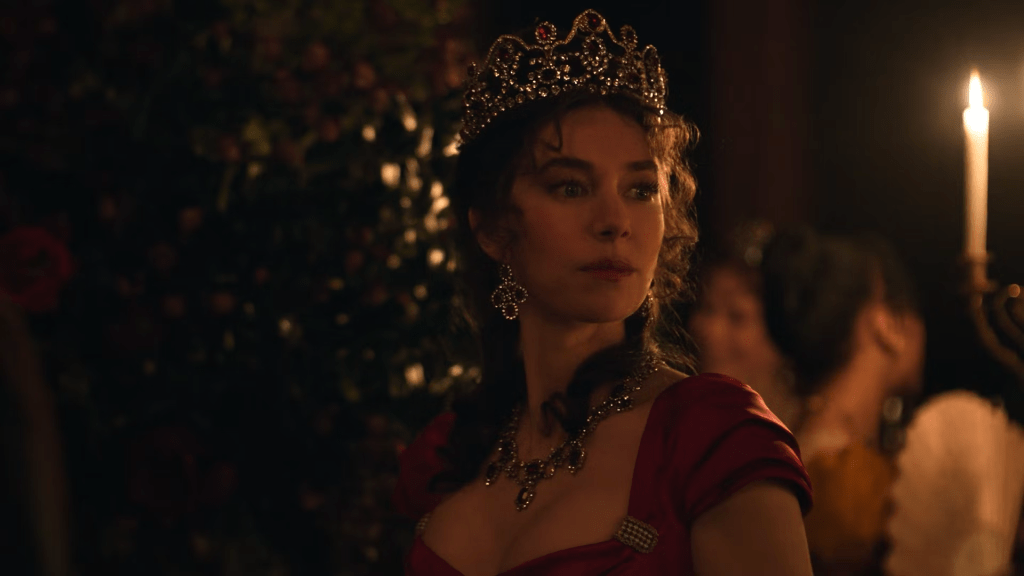
Ciara: “Vanessa Kirby’s performance as Josephine is the best part of Napoleon. She is the sun around which all else revolves. Both cold and enchanting, you’re never quite sure if she loves him, has ever loved him, or just knows what cards to play. She toys sexually with Napoleon, like a child torturing an insect – the bit where she shows him what’s between her legs is masterful domming – yet is blasé or utterly bored during what passes for their lovemaking.
She is fiery passion and jealous rage, she is cooly calculating and matter-of-factly pragmatic. None of this seems false. But there is a gap between us and her, one Kirby keeps just wide enough for us to deeply know Josephine yet not truly understand her. Napoleon, too, can’t quite grasp her: at times, she seems to be the one thing in the galaxy that he cannot wholly possess. Well: her, a control on his temper, and good taste.”
Ciara’s Runner-Up: Penélope Cruz as Laura Ferrari in Ferrari – “As Enzo Ferrari’s wife Laura, Cruz is somehow huge, fearless, wild, and quiet, understated, power coiled in her body like a panther even as she wears her beating, bloodied heart on the outside. Her grief for her son is ostentatious and still feels like she’s holding it back. It’s her movie, and Enzo Ferrari is just living in it. Whenever Penélope Cruz is not on screen, all the other characters should be asking ‘Where’s Penélope Cruz?’”
Dean’s Runner-Up: Da’Vine Joy Randolph as Mary Lamb in The Holdovers – “Da’Vine Joy Randolph is an absolute gift as Mary, head cook at a snooty boarding school with no tolerance for bullshit and a hole in her heart a mile wide since her only son was killed fighting in Vietnam. In a big year for grief at the movies, no one else played it so raw and real and human: not just stricken by loss, but adrift in life without the only purpose she ever had. Her breakdown at the Christmas party should be studied in acting schools for years to come.”
—
BEST ORIGINAL SCREENPLAY – Justine Triet & Arthur Harari for Anatomy of a Fall

Dean: “Anatomy of a Fall is so brilliantly structured it dazzles me. Like 12 Angry Men, it understands that half the tension in a legal drama comes from the careful withholding and calculated yielding of information to the audience. We never get anything close to a full picture in this film, whether it’s about the true circumstances of the titular fall or the decade-plus marriage that preceded it, but everything we do learn – or think we learn, given everyone is constantly lying – is doled out precisely when it’ll twist the knife most sharply. The scene where we see Sandra and Samuel fight, only for it to cut back to the courtroom listening to the recording right when it turns violent, leaving only the sound to interpret, is as excruciating as it is exquisite.
But it’s most cutting insight, rarely stated outright but inescapable nonetheless, is how farcical the court’s claimed devotion to truth is when literally no one involved – prosecution, defense, witness or accused – is actually motivated to seek it. It’s a murder trial that somehow features as much literary analysis as forensic analysis, as well as a hilarious back-and-forth about whether the victim was being misogynistic when he repeatedly blasted an instrumental reggaeton cover of 50 Cent’s ‘P.I.M.P.’ while his wife was trying to do an interview. And the way it plays with the linguistic tension of the German Sandra never learning French, both in her marriage and in the trial itself, is fascinating.”
Ciara’s Runner-Up: Celine Song for Past Lives – “One of the best movies about the effect of im/emigration on identity I’ve ever seen, and one of the best love stories, without even really being one. Celine Song’s script consistently resists the conventions it plays with to make for something fresh and aching as blood from a papercut.”
Dean’s Runner-Up: Emma Seligman & Rachel Sennott for Bottoms – “Somewhere between Ferris Bueller’s Day Off and Wet Hot American Summer on the scale of teen movie surrealism, Bottoms was pound-for-pound the funniest film of last year. Josie catastrophising her way from not getting laid in high school to begging PJ to visit her broken future family on Sundays, Mr. G turning on a dime from feminist to misogynist and back, Sylvie revealing the reason she wants to kill her stepdad is that he’s too enthusiastic about movie nights. I don’t think I’ve laughed this hard and often since Popstar.”
—
BEST ADAPTED SCREENPLAY – Greta Gerwig & Noah Baumbach for Barbie
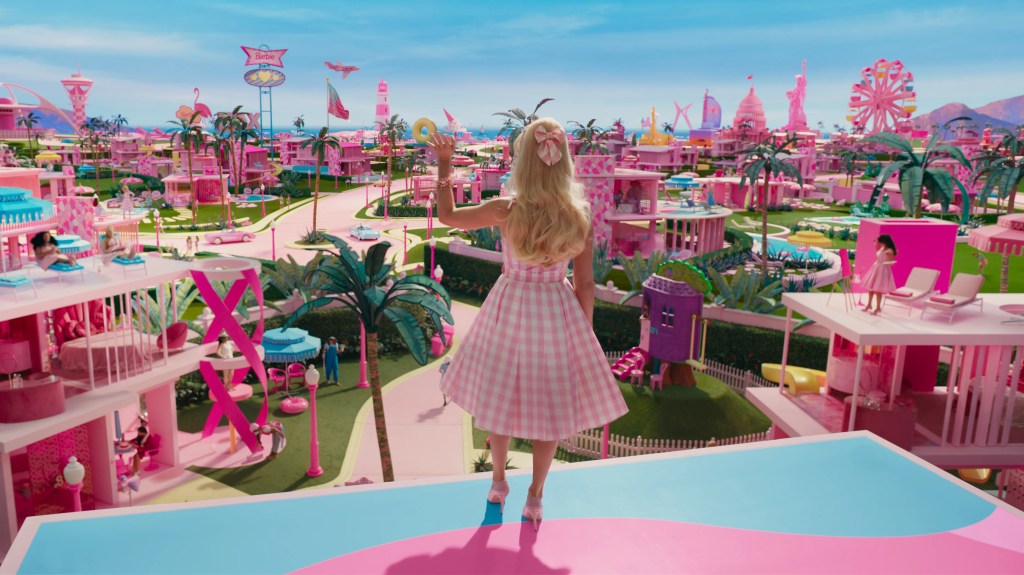
Ciara: “First things first: yes, Barbie is an adapted screenplay. It’s based on one of the most enduring cultural figures of the last half century: Barbie. The characters of her universe, the decades of lore she’s accumulated. And Barbie plunges its fists deep into that lore to, for one, explode all the contradictions of Barbie’s role in shaping our world. An icon of women’s liberation and patriarchal oppression, simultaneously, inseparably. Gerwig and Baumbach manage to have Barbieworld reflect both sides of that coin: Barbieworld has a female president, a female everything, since, as Gerwig has pointed out, Barbie ‘went to the moon before women had the ability to get credit cards.’ Yet when Barbie develops cellulite on her leg, the other Barbies are shocked and disgusted. This is not a simple genderswapped version of our world, but something knottier, at once more and less familiar. It’s the world of little girls’ playtime, where Kens aren’t subservient, they’re superfluous. And from that starting point, Barbie produces an existentialist examination of gender politics – not just in its critique of female gender roles, but its engagement with masculinity, too. It’s wonderful.
I always suspected Greta Gerwig’s Barbie movie would be good, but I never expected this. And so much of that comes back to Gerwig and Baumbach’s audacious screenplay: it’s Wings of Desire in disco drag, opening with an elaborate 2001: A Space Odyssey homage. It has a gag rate worthy of the zaniest comedies of the 1980s and a dream ballet about Ken feeling sad. The movie has, save maybe Beau is Afraid, the best punchline of the year. I still can’t believe they pulled it off.
Also, it made me cry. ‘We mothers stand still so our daughters can look back to see how far they’ve come,’ Ruth Handler, Barbie’s creator, says. Stab me through the heart.”
Ciara’s Runner-Up: Andrew Haigh for All of Us Strangers – “A gorgeously structured screenplay that, in its analysis of intergenerational gay identity, adds layers of meaning from the Japanese source novel, and more importantly, tore my heart to pieces. It sewed it back together, but you can still see the crooked seams. The milkshakes in the Eddie Rocket’s-ish American-style diner? Gah.”
Dean’s Runner-Up: Tony McNamara for Poor Things – “Poor Things is a relentlessly weird film, bizarre in premise and every facet of its execution: demented performances, surreal production design, anarchic direction. But it’s also a film largely driven by conversation, about politics, philosophy, science, sex, and the most essential questions of the human condition. Tony McNamara’s fantastic screenplay is the foundation on which it’s all built, and the fact it manages to hold all these facets both up and together while also being extremely funny is honestly kind of miraculous.”
—
SPECIAL ACHIEVEMENT AWARD (GODZILLA AWARD FOR GODZILLA, AS WELL AS HIS FRIENDS OR ENEMIES) – Godzilla Minus One

Ciara: “Godzilla Minus One is set before the events of the original, 1954 Godzilla movie, hence the title. It takes place shortly after the Second World War, and does a frankly incredible job of both critiquing the terrible crime the United States committed when it dropped the nuclear bombs, and being an impassioned rebuke of Imperial Japan. Both are placed in a continuum that does not value human life, and the film becomes a story about choosing against any ideology that does not value human life first and foremost. Also, Godzilla is in it.
Our hero is a failed kamikaze pilot wracked by survivor’s guilt: surviving being a kamikaze pilot, surviving an attack by a mysterious dinosaur-looking creature, surviving the war where his parents died in the bombings. He ends up taking in a young woman and her baby, leading everyone he meets to assume that they’re his wife and daughter. He gets a job on a minesweeping vessel, charged with disposing of naval mines from the war. But wouldn’t you know it, Godzilla’s down there too. And he’s pissed. Godzilla Minus One combines the structure and style of a Steven Spielberg World War II drama with that of a Steven Spielberg monster movie. This is, frankly, such a genius move that I am shocked Steven Spielberg hasn’t done it. It made me punch the air in pure joy.”
—
SPECIAL ACHIEVEMENT AWARD (UNIQUE & ARTISTIC PICTURE) – The People’s Joker

Dean: “Not since Titane have I had so much trouble merely describing a film, but I’ll give it my best shot: The People’s Joker is a semi-autobiographical coming-of-age film about a young and initially closeted trans woman called Vera who moves to the big city to make it as a stand-up comedian. Only the big city is Gotham, a police state ruled by the fascist autocrat Batman, where comedy is strictly outlawed except when performed at UCB (United Clowns Bureau) or on its flagship TV show, UCB Live, produced by CGI Lorne Michaels. Dissatisfied with UCB’s narrow view of comedy and strict gender segregation – only male cast members, or Jokers, are allowed a personality while female cast members, or Harlequins, serve as interchangeable eye candy – Vera teams up with fellow outcast Oswald Cobblepot to start an underground anti-comedy club, where she meets and falls for an edgy trans man called Mr. J.
It is, obviously, a (very, very unauthorised) parody of DC superheroes, and 2019’s Joker in particular, but also a vicious satire of the institutions of American comedy, a heartbreaking exploration of abuse in queer relationships and a gonzo mixed media fever dream where the Penguin’s nose prosthesis is very clearly a condom, among many other things. It features a moment of sudden cruelty that made the entire crowd at my showing gasp, and a cameo by Robert Wuhl from Tim Burton’s Batman that nearly made me pass out laughing. The audience for this film is vanishingly small, but if you’re in it, it will melt your face off.”
—

 The Sundae