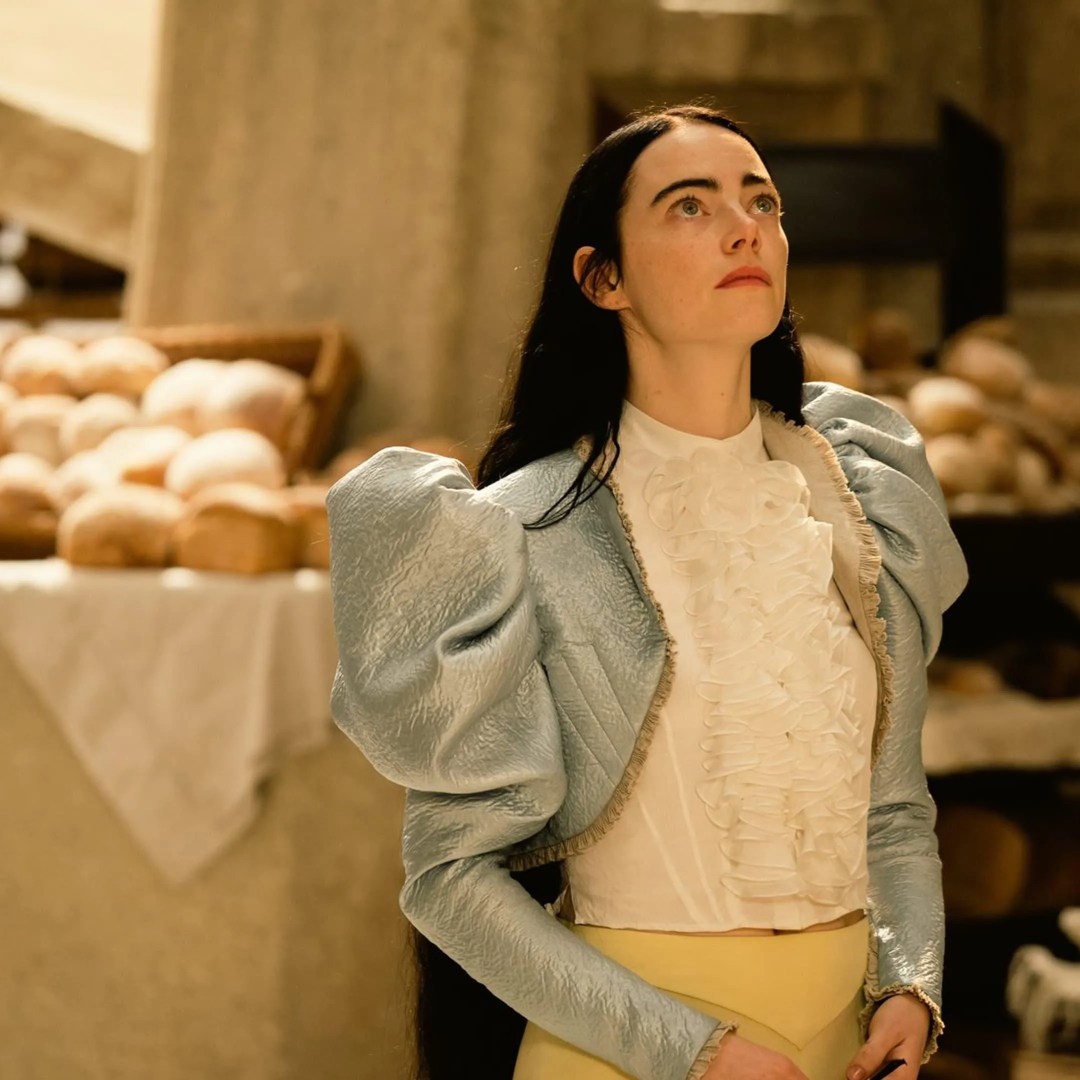
A woman stands atop the parapet at the edge of a bridge. Her dark hair is pinned in curls at the back of her head, loose strands near her face caught in the wind. Her deep blue dress has a Victorian high collar; its flared skirt would trail on the ground behind her if her feet were on the ground. The camera pans up to the endless blue of the sky, and then back down as the woman jumps into the endless blue below her. In Yorgos Lanthimos’s Poor Things, her death becomes a birth. Neither her own rebirth nor the birth of the unborn child in her womb, or maybe both those things. A new person is scavenged from the existing materials. Her name is Bella Baxter.
The basic premise of Poor Things is this: Dr. Godwin Baxter (Willem Dafoe) found the corpse of a woman who had taken her own life, before rigor mortis had set in—dead but fresh, with a still-living fetus inside her. “It was obvious,” he tells his student Max McCandles (Ramy Youssef). “Take the infant’s brain out and put it in the full-grown woman, reanimate her, and watch.” The film is a riff on Frankenstein that shucks off two centuries of cultural baggage to recapture how messed up Frankenstein must have seemed when Mary Shelley first wrote it, long before Dr. Frankenstein’s creature was meeting Abbott and Costello (or Alvin and the Chipmunks). Part of what it discards in the process is any stability around who, if anyone, is the “monster” in a Frankenstein story.
Godwin—who Bella affectionately calls “God”—is himself both Frankenstein and the creature. As a child, he was subjected by his father to experiments that have left his face carved with deep, thick scars, his genitals non-functional, and a digestive system that requires being hooked up to machinery to produce gastric juices. “Dafoe plays every movement and gesture as labored,” Angelica Jade Bastién writes for Vulture. “He shuffles and sighs and sulks.” A student in his surgery class derisively calls him “the monster” because of his visible deformity. Yet God seems to regard his father not as an abusive sadist, but a man of science unwilling to put moral or emotional considerations above the pursuit of knowledge. He seems to admire this cool detachment and emulates it in his own work: “Our feelings must be put aside,” he tells Max. “Do you think my father could have branded me with hot irons on the genitals the way he did if he could not put science and progress first?” In Shelley’s original, Dr. Frankenstein shrunk with horror from his creation, next to which God’s problem is almost a photonegative: his paternal feelings towards Bella are an affliction he tries to overcome, though he never quite manages it.
But the film’s point of view is wholly Bella’s: she, too, is both the creator and the creature, but entirely her own. She is her own mother and her own daughter, “born” into a crisply black-and-white, steampunk version of Victorian London and trapped in the confines of God’s mansion. When she meets Duncan Wedderburn (Mark Ruffalo)—a lothario who warns her not to become a jealous lover demanding constancy before himself becoming exactly that—she embarks on a journey of discovery, adventuring across a funhouse-mirror Europe in which trams traverse Lisbon’s skies and city streets come in the colors of lemon drops, cherry blossoms, and sherbet.
Early last year I wrote about Poor Things as a film about autism and neurodivergence for Current Affairs. You can read it here.
Last summer, at the peak of the Barbenheimer phenomenon, it seemed like cinematic gender essentialism – the kind that made a Ghostbusters reboot a lightning rod for controversy the guts of a decade ago – had finally died off. Barbie and Oppenheimer were released on the same day, and what was set up as a versus between the “boy movie” and the “girl movie” quickly became a both/and. There were no movies for this gender or that, just a couple of great films that we all wanted to see. I saw them back-to-back. Loads of people saw them back-to-back, and tons more watched both films at some point in their long runs on the big screen. The movies were back, and this time, quadrants could be damned.
Then awards season came along and, as usual, crushed all my hopes and dreams.
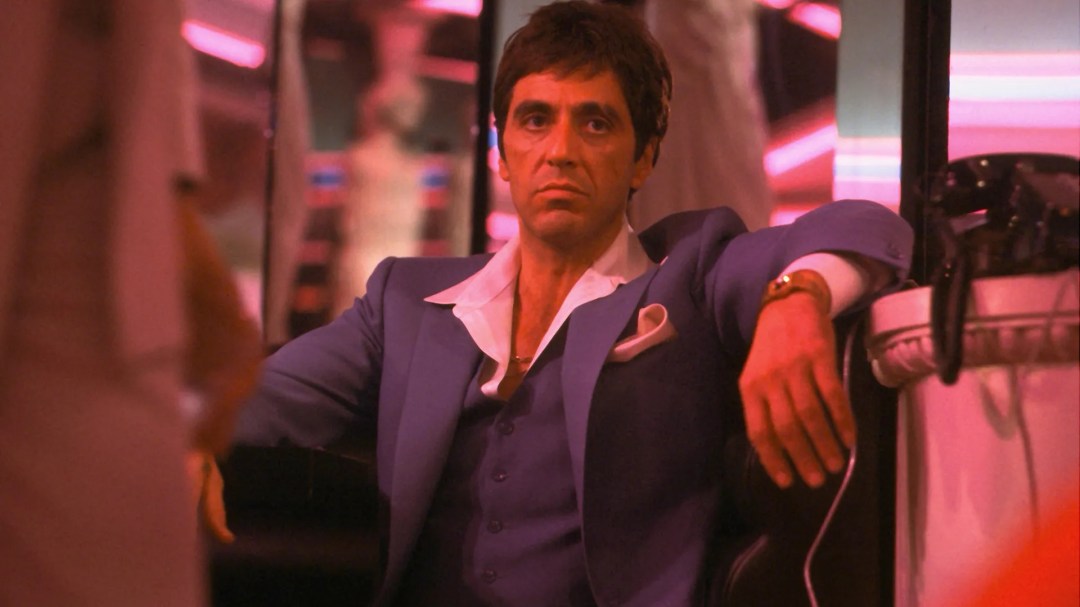
I wrote about the girliest movie for girls going, Brian De Palma’s Scarface, for Crooked Marquee! You can read it here.
Ciara and Dean co-host The Sundae Presents, a podcast in which they each make the other watch films they haven’t seen. For the last regular episode of the year, Ciara showed Dean one of her first favourite films, Best Picture winner Kramer vs. Kramer. They talk about whether it’s balanced, whether it’s antifeminist and which of the characters Dean wanted to kill at various points.
Chasing Amy does not exactly hold an esteemed position in the cultural memory. Partly this is because of Kevin Smith’s current station: the director of films no one likes, and the author of the worst tweet ever. But the bigger problem is that its logline makes it sound genuinely offensive: Holden (Ben Affleck) falls in love with lesbian Alyssa (Joey Lauren Adams). And she falls in love with him right back.
I wrote an impassioned defense of Kevin Smith’s Chasing Amy on its 25th anniversary over at Crooked Marquee! You can read it here.
After directing Australian New Wave classics Picnic at Hanging Rock and The Last Wave, Peter Weir made The Plumber, a television film that — like Steven Spielberg’s Duel — was released theatrically in overseas territories. It’s a forgotten middle child of Weir’s filmography. Not a ground-breaking piece of art like the dreamily stylish Picnic at Hanging Rock nor a universal cultural touchstone like later Weir films Dead Poets Society or The Truman Show. But beyond its beginnings on television, the pleasures The Plumber offers are more off-kilter. It goes down satisfyingly sour.
I wrote about Peter Weir’s TV movie The Plumber for Certified Forgotten! You can read it here.
Ciara and Dean co-host The Sundae Presents, a podcast in which each of us makes the other watch films they haven’t seen. This episode, Ciara makes Dean watch one of her actual favourite films, Dog Day Afternoon. They talk about sexuality and gender, optimism and the Attica prison massacre.
Ciara and Dean co-host The Sundae Presents, a podcast in which each of us makes the other watch films they haven’t seen. This episode, Dean shows Ciara D.W. Griffith’s 1920 silent melodrama Way Down East. They talk about its weird Christian feminism, silent film acting and sleepy kitties.
“To get a little academic for a second, the primary emergency of gay history in its first decades was to uncover and to restore histories of gay movements and of gay heroes. And while the culture of academic research has certainly moved on from that, the public conversation really hasn’t.”
Say Anything are a strange band in the history of pop punk, not least because, well, are they a band? Max Bemis, lead singer and sole constant member, wrote all their lyrics and most of their music, and his work is, if not autobiographical exactly, then certainly confessional, in a way that reminds me alternately of Sylvia Plath and Eminem. He mentions people in his life by name in his songs a lot, particularly his wife and children in his later career, and usually without bothering to explain who they are for the unfamiliar listener. But other members of Say Anything have co-written music on most of their records, and many of them just credit Say Anything, rather than breaking down who did what. On the sliding scale between a solo project with a band name and a regular band with a primary songwriter, I tend to file Max Bemis and Say Anything in the same folder as Robert Smith and The Cure, Trent Reznor and Nine Inch Nails or John Darnielle and The Mountain Goats: bands that consist of one person and whoever they’re making music with at the time, too collaborative to be solo projects, but too mercurial to feel like a regular band.
Their sophomore album …Is a Real Boy is widely acclaimed as one of the best pop punk albums of all time and particularly regarded as one of the crown jewels of Bush-era emo, but they’ve pretty much never had a major hit. Not even …Is a Real Boy, which didn’t chart in a year when Blink-182, Green Day, Good Charlotte, Simple Plan, New Found Glory, Taking Back Sunday and even The Offspring (on their seventh album!) made the Billboard Year-End 200. Good Charlotte had two albums on it, and Green Day moved from #86 in 2004 to #2 in 2005 as the worldwide success of American Idiot turned it into one of the best-selling albums ever. My Chemical Romance released their sophomore album, Three Cheers for Sweet Revenge, in 2004 too, and also missed the year-end chart, but in 2005, they joined Green Day in the top 200 with Fall Out Boy, Simple Plan, Good Charlotte, Bowling for Soup and Jimmy Eat World. Say Anything had no such luck.
…Is a Real Boy had by far the biggest single of Say Anything’s career, “Alive with the Glory of Love”, a staple of alternative rock radio then and of alternative rock playlists now, but not a song that caused much of a ripple in the zeitgeist: it peaked at #28 on the alternative chart. Every subsequent Say Anything album has charted, but every subsequent Say Anything album except In Defense of the Genre, their sprawling double album full of collaborations with other pop punk and emo artists, also sold fewer copies than …Is a Real Boy. Almost twenty years later, …Is a Real Boy is still the album they’re primarily or even exclusively known for. They’ve had two other singles chart – “Baby Girl, I’m a Blur” and “Hate Everyone” – but “Alive with the Glory of Love” is still the closest they’ve come to a hit song. It’s not an uncommon story, really, but it just feels kind of ridiculous that a band this influential and iconic within the genre, who’ve collaborated with Gerard Way, Hayley Williams, Tom DeLonge, Matt Skiba and dozens of other beloved pop punk, emo and indie artists, have never really been that popular. It’s not like they’re critical darlings either: the reception for most of their albums after …Is a Real Boy skews positive, but it’s usually mixed and frequently polarised. I guess they’re kind of a love-it-or-hate-it thing, but even Marmite sells, for God’s sake.
…Is a Real Boy is a masterpiece, possibly the best pop punk album ever, and certainly my favourite, but it’s also been a bit of an albatross around Bemis’s neck. A lot of the band’s later experimentation is a fairly transparent effort to escape the shadow of …Is a Real Boy by refusing to even have a core sound. The second verse of “Judas Decapitation”, from their 2014 album Hebrews, is a screed aimed directly at the archetypal bad Say Anything fan who venerates …Is a Real Boy and hates the work the band has done since Bemis became happier, healthier and met his wife, Sherri DuPree of Eisley: “I hate that dude! / now that he’s married / he’s got a baby on the way / Poor Sherri!” Bemis is open about suffering from bipolar disorder and famously experienced a severe manic episode from the stress of making …Is a Real Boy, so there’s always been a dark undercurrent to the idea he needs to “go back” to making albums like it, as if he can’t make good music unless he’s untreated. You can hear the venom in his voice as he spits out the last lines of that verse: “be nineteen with a joint in hand / never change the band / never ever be a dot dot dot real man”, with the “dot dot dot” in the wrong place, just to piss them off even more. It was a bit of a surprise, then, when Bemis announced a sequel.
Oliver Appropriate, released in 2019, is the band’s presumptive final album, released a few months after a lengthy statement in which Bemis came out as queer, revealed he was retiring from touring for health reasons and announced the end of Say Anything as a recording project (though the third paragraph promises they’ll “return one day to play festivals and scoff at our career”.) Like many concept albums, the concept “lore” is almost entirely secondary to the experience – I’ve never read the liner notes of any concept album ever – but unlike, say, The Black Parade or the concept albums of Cursive (one of Bemis’s more transparent non-pop punk influences), it has a fairly clear narrative, even clearer than pop punk’s definitive concept album, American Idiot. Oliver is a washed-up, single, middle-aged, ex-punk rocker punching the clock at a marketing job and spending all his free time and money on drink and drugs, drifting from bar to bar, club to club, party to party, falling into bed at the end of the night with whatever woman will have him.
Then he sees Karl at a bar, and it’s like a bolt of lightning right into the darkest part of his heart, the secret place he’s been hiding his attraction to men from himself and everyone else. It’s a beautiful album about the misery of alienation, the agony of the closet and the thrill of first love. It’s also a very dark horror story: the album ends with Oliver drowning himself in the San Francisco Bay with Karl’s body.
Body horror is a genre characterised by what Ronald Cruz calls the “manipulation and warping of the normal site of bodily form and function”. It is a genre which unsettles us through its disregard for the human body as it assaults audiences with distortions of the familiar sights, sounds, movements, and functions of the body. Throughout the eight episodes of HBO’s gothic thriller Sharp Objects (2018), there is a growing unease regarding the body which erupts in moments of supreme shock and disgust. The three central characters – Camille Preaker, her mother Adora and sister Amma – all display the genre’s “gruesome disregard for the human body” in various ways as they exist within the narrow confines of femininity permitted in the small town of Wind Gap, Missouri. The female body in Sharp Objects is the site of the series’ most shocking moments of horror and the driving force of the entire mystery plot: the horror it endures and produces is the horror of the series.
The Crying Game has been reduced to a single scene in the public imagination. Fergus (Stephen Rea, it wouldn’t be a Neil Jordan film without Stephen Rea) is about to have sex with Dil (Jaye Davidson) for the first time, when it’s revealed – both to Fergus and the audience – that she is transgender. She takes off her robe and the camera tilts down her body to show a penis. Fergus’s reaction is, to say the least, not great: he hits her in his attempt to push her away, and he throws up in the bathroom. Dil meekly says she thought that he already knew.
If you know anything about The Crying Game, it’s this scene. It’s this twist. To some extent, that reputation was deliberately cultivated: after flopping in the UK, it became a hit in the US with a marketing campaign built around the twist. And in isolation, it makes The Crying Game sound like a relic, in a way I’m sure puts people off watching it. When critics revisit The Crying Game now, it’s mostly to measure its understanding of trans people against our modern sensibilities. It’s good to re-examine representation of trans characters from the past, obviously, but it can be reductive when historical transness is purely viewed through modern lenses. Mainstream understanding of trans people has transformed so quickly so recently that a film from 1992 sounds like an ancient artefact.
But The Crying Game is an incredibly rich, complex, and beautiful film. It has a deft touch for the nuances of gender and sexuality, but it’s about so, so much more than that. It’s a film about shifting identities whose own identity is in constant flux: it’s a thriller, a romance, something else entirely. And at its centre is a character whose identity is shifting: not Dil, but Fergus.







 The Sundae