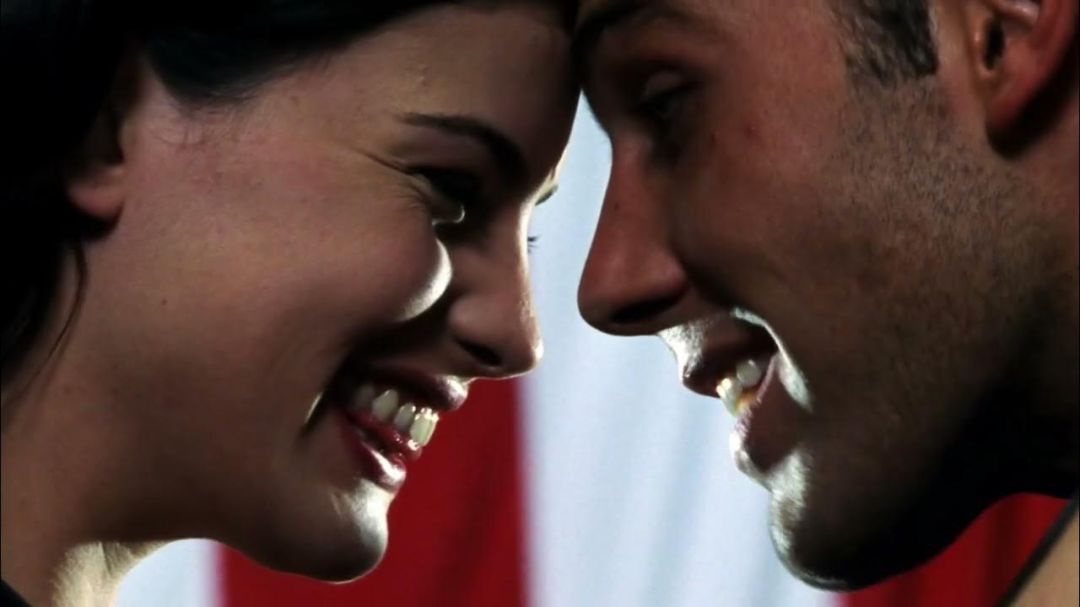
Armageddon is the kind of movie that people say “not that it’s a great movie or anything but…” before they say anything nice about it. It’s a Michael Bay movie about guys who work on an oil rig going to space to save the Earth from an asteroid, and therefore dumb, and therefore sucks. One day I’ll write about how it is a great movie, actually, because Michael Bay is a genius and he deserves his flowers after being treated as a critical punching bag for most of his career. But right now, I want to tell you about my favourite scene.
The oil workers, having been given a crash course in being astronauts, are about to board the rocket. They’re in their space suits. Harry (Bruce Willis) hugs his daughter Gracie (Liv Tyler) goodbye, promising to see her in a couple of days. Then Ben Affleck, who plays her boyfriend AJ, holds her close, swaying her in his arms as he sings: “All my bags are packed, I’m ready to go…” It’s ‘Leaving on a Jet Plane’, which manages to be fun and silly at a potentially tense moment, but also resonate as terribly romantic and bittersweet, heart utterly on sleeve. Affleck first sings in a quiet intimacy, forehead pressed to Tyler’s, and then belts with buoyant exuberance, sweeping her up off her feet.
He can’t sing worth a damn. It’s beautiful.
Affleck does not have a note in his head. He gets by passably in the verse, sticking to a register not far above a tuneless hum. But his voice cracks horribly when he tries to sing out in the chorus: straining for a high note that is not all that high. The noise that comes out of his throat is the kind that, within a few years of Armageddon’s 1998 release, would become a staple of “funny” TV talent show auditions. When you hear a voice crack like that on American Idol or The X Factor or Britain’s Got Talent, you’re meant to laugh, because it’s the sound of delusional self-confidence bursting on contact with air. But in Armageddon, it’s the sound of being in love and saying goodbye, wistful and aching and overjoyed. On American Idol, anyone who sounds like that is not meant to sing, and if they sing anyway, it proves that they’re a freak and a loser. In Armageddon, it doesn’t matter that Ben Affleck is tone deaf. That’s not what he’s singing for.
There are many reasons humans sing, but one of them – and perhaps the most beautiful – is to communicate emotions that are too big, too intense, to speak. When he was promoting La La Land, Damien Chazelle pointed to this as the underlying principle of the musical as a genre: “… the purity of the idea that you break into song when you’re too emotional to do anything else, and that when Gene Kelly starts to dance it’s because he can’t express an emotion any other way. … you’re so happy and you’re so in love that you just have to start dancing.” Musicals elevate that principle to a law of the universe, but I do think the basic idea is true in real life, too – “that if you feel enough, you break into song.” If you’re happy and you know it, sing along.
When AJ sings ‘Leaving on a Jet Plane’, Harry scoffs that he never takes anything seriously. And he’s right, on one level: singing is a way for him to make a joke out of this crazy, scary moment. But was Harry taking it seriously when he told Gracie, moments earlier, that he’d see her in a few days? They’re going to space to destroy a gigantic approaching asteroid: any or all of them could die up there, and there’s every chance she could die right here on earth, too. Harry’s goodbye was a deflection from the unbearable weight of what he’s about to do. By comparison, AJ croaking I hate to wake you up to say goodbye and let me know you’ll wait for me and don’t know when I’ll be back again is a stunning act of emotional transparency. They’re the things that neither he nor Harry could say, but that AJ finds it in him to sing, however badly. And it cuts through for the other characters, too: Michael Clarke Duncan, Steve Buscemi and Ken Campbell join in, their genuinely good voices shaping what AJ started into a makeshift barbershop quartet.

It’s normal – expected, even – for children to sing out when they’re overcome with feelings. But children are allowed be vulnerable, and embarrassing, and lacking in self-awareness: that’s their whole deal. We sing less when we get older. Singing, like laughing or crying, is an expression of emotion whose scale may be inarticulable in words. All three are demonstrations of vulnerability, expressing your innermost self and leaving yourself open to the judgement of others. But unlike laughing or crying, singing is voluntary: it is wholly in our control if and when we do it. To sing in front of others – to be listened to singing – means consciously letting down your defences to express those too-big, too-much feelings. It means exposing your soft underbelly and hoping no-one will stick a knife in.
Outside of the shower, at least, we tend to think of singing as something done to impress others. Singing as a performance for an audience. It’s for their enjoyment, which rests upon some degree of technical proficiency. (Or at least an ability to stay roughly on-key.) And that is certainly a big part of what singing is for. But it’s easy for that to obscure the other reasons people sing – the ones that I have to think about when my face hurts smiling listening to Ben Affleck make a horrible, strangled sound trying to sing ‘Leaving on a Jet Plane’. The logic of performance functions to excuse the irrationality of song: reducing music-making to a simple exchange between a skilled individual on one side and a crowd in need of diversion on the other, not something guttural and vulnerable and true. Bad singing – not pretty but untutored voices, but bad singing – denies that logic. Once it’s stripped away, what’s left is the emotionality and vulnerability of the act. Whole genres of music, from punk to mumble rap, have been founded on rejecting technical proficiency to try and capture that raw essence. But bad singing in narrative media is especially compelling to me because it rarely has that attitude of defiance against authority – a defiance that’s good and valuable but, in its own way, a logic to excuse the irrationality of song. Bad singing in a film or TV show means the character exposing themselves – making for the most transcendent characterisation you can do.
There is no better example, of course, than Cameron Diaz in My Best Friend’s Wedding. Jules (Julia Roberts) has realised she is in love with her best friend, Michael (Dermot Mulroney), after he gets engaged to Kimmy (Diaz). In an effort to humiliate her in front of her fiancé, Jules signs Kimmy up for karaoke. She sings ‘I Just Don’t Know What to Do with Myself’, and I don’t think she hits a single right note. At first, Kimmy is stiff and awkward, and the crowd is hostile: someone shouts “You suck!” and Jules seems satisfied that her plan is working. But then the crowd comes around. It’s not because Kimmy finds her groove, or gains confidence, or gets even a modicum better at singing. It’s because she keeps going. They clap to the beat, and cheer when she hits a particularly bum note. Kimmy puts more power behind her voice: sounding just as terrible but owning it. Letting herself go, even though it’s embarrassing, because there are worse things in this world than being embarrassing, than being embarrassed. Michael looks up at her in awe, like he’s falling in love with her all over again. Jules, realising she’s lost this battle, joins in clapping. When Kimmy finishes singing, Michael says, “that was terrible” before pulling her into a passionate kiss, and it sounds as good as “I love you.”
I don’t even like My Best Friend’s Wedding that much, but this scene is incredible. Cameron Diaz’s singing is awful in a way that feels fearless for her as an actress, even as she captures the very real fear thrumming through Kimmy as a character. Kimmy makes the decision to feel the fear, the embarrassment, and not let it stop her. To be self-aware but not self-conscious. It is sweet, and charming, and more than anything, human. The genre conventions of the romcom demand that Michael ends up with Jules, so the easy move would be for Kimmy to be some one-dimensional blonde bimbo ultra-bitch standing in Jules’s way until the scales fall from Michael’s eyes. If she had sung well, that’s how it would have felt. But she sings so badly that it’s admirable: she’s resilient, and at once humble and brave. In the karaoke scene, you understand exactly how Michael fell in love with her. You fall in love with her, too.

There is perhaps no love greater than to love someone’s bad singing. In the title sequence of All in the Family, Edith (Jean Stapleton) and Archie (Carroll O’Connor) duet on ‘Those Were The Days’. Lyrically, it expresses (and shows the absurdity of) Archie’s reactionary nostalgia. I still giggle at “we could use a man like Herbert Hoover again.” But what’s fascinating about it in performance is that it’s a call-and-response – Archie singing one line, Edith the next, and the third together – and that the difference in their singing ability is vast. Archie sings in a smooth, rich baritone. Edith, on the other hand, sings in a shrill screech even when she doesn’t veer off-key – and oh boy, does she veer off-key. On the show, Archie is often cruel to Edith – calling her a dingbat, telling her to stifle. But as they sing together, Archie never looks annoyed, or impatient. He looks borderline beatific: it’s almost certainly the happiest he’ll seem for the rest of the episode. Edith looks happy, too, and doesn’t hesitate to give it her all. On All in the Family, their marriage rarely seems especially loving, closer to a Beckettian couple in its inevitable stuck-together-ness. But there are moments where you see that they really do love each other. The opening sequence, where Edith wails like a cat and Archie happily croons alongside her, serves as a weekly reminder.
Irony and sincerity are usually talked about as mutually exclusive modes: something can be arch and funny and knowing, or it can be earnest and heartfelt and guileless. One of those is always good and one is always bad, and which is which depends on who you’re talking to. As a young person, I was very taken with David Foster Wallace’s critiques of irony as essentially sneering and deadening: “today’s irony ends up saying: ‘How totally banal of you to ask what I really mean,’” he writes in an essay in A Supposedly Fun Thing I’ll Never Do Again about American television, “Anyone with the heretical gall to ask an ironist what he actually stands for ends up looking like an hysteric or a prig.” I still think irony can be a defensive, even evasive, posture. But I also think that sincerity and irony aren’t really poles apart. Sentimentality and melodrama can exist without being played perfectly straight. RW Fassbinder’s melodramas are extremely serious and dark when you watch them, but seem funny when you remember them. When Bob Dylan makes a Neil Diamond pastiche album where it sounds like his backing singers are hearing each song for the first time, it is conceptually hilarious, but it’s not a joke album: it’s sincere, and it sincerely rules, even though it is funny for it to exist. Ditto McFly making a 1980s hair metal album. Something can be a joke and not a joke, not because it’s trying to trick you or evade meaning, but because it is possible for something to be at once funny and true.
Bad singing is almost always funny. But it is simultaneously – inseparably – vulnerable, open, and sincere. We are so often afraid to express ourselves in case other people laugh, but scenes of bad singing remind me: so what if they do? Singing is nice, and laughing’s nice too. The impulse towards cringe is one that not only causes you to sneer at others, but to cut yourself off from some of the most basic and most beautiful ways to express yourself. And when we don’t find ways to express our emotions, we alienate ourselves from them. This is part of what Arlie Russell Hochschild was describing when she coined the term “emotional labour” to describe flight attendants whose faces stay frozen in a smile when they get home. Not all of us have jobs that demand large amounts of emotional labour, but the more you have to manage your emotions for whatever reason, the harder it is to feel your “authentic” emotions. Singing is one of the best ways to let your feelings out, and yet – or so – it’s embarrassing, and must be kept covert. But anything worth singing is worth singing badly. “Dance like nobody’s watching” is an inspirational cliché, and yet who amongst us sings as if no-one’s listening?
I’ll tell you who. Julia Roberts in the bathtub in Pretty Woman. She doesn’t miss a beat when Richard Gere walks in, even though he’s on the phone.
“Don’t you just love Prince?” she says, self-deprecating but not cringing.
“More than life itself,” Gere answers.

 The Sundae