Check out previous instalments here.
Thus spoke the prophet: “Well, the years start comin’ and they don’t stop comin’.” There were elections and wars, genocides that proceed unabated and natural disasters that we can hardly call natural when we’ve created conditions that make them inevitable. So many celebrities died that there would have been a whole “fuck you, 2016!”-style outcry if we didn’t have other things to worry about: those who lived long lives, like Maggie Smith, James Earl Jones or Donald Sutherland, and those whose lives were cut tragically short, from Shannen Doherty to Liam Payne. (Reports of Noam Chomsky’s death were greatly exaggerated.) But there were bright spots, too – Mickey Mouse finally entered the public domain, all that Mikey Madison stock we bought early is paying dividends, and Terrifier 3 made people throw up. (If that one doesn’t sound like good news, please factor in some 2000s kid nostalgia.)
It was a year of endings and beginnings, as are, admittedly, all years. Ciara finished her thesis after years of toiling in the PhD mines. Dean suddenly became an investigative journalist, and he rocks at it. Ciara’s extended family found out that she’s a writer or something when she wrote about her epilepsy journey for the Irish Independent, and Dean helped found a network of community groups to promote integration in Tipperary. Ciara watched all of Seinfeld for the first time, and Dean finally finished Fez, a video game he first purchased in 2012. We both launched new podcasts: Ciara’s is about films, as is her wont, and Dean’s is about Tipperary, as is his wont, these days. Both of them are excellent, if we do say so ourselves.
As ever, we’ll be singing the praises of our favourite films released in 2024 in March, for the ninth (ninth!) annual Sundae Film Awards. Right now, we’re going to look back at the best films from the rest of the medium’s history that we watched for the first time this year, from North Korean kaiju adventures to camp classics about child abuse.
Tol’able David (1921)

Ciara: “Tol’able David was both massively acclaimed and a huge hit on release, but it’s not talked about much these days, even among silent film fans. But everybody who called it a masterpiece in 1921 was right, and the rest of us are idiots.
The film opens by establishing an idyllic vision of rural life in West Virginia. The big problem is that David’s family baby him: he’s scrawny and sweet and desperate to prove himself, but his parents, older brother and the pretty girl next door are at pains to remind him that he’s still a boy, not a man. He wants to shoulder the weight. He wants, more than anything, to drive the hack: the carriage his brother drives to deliver post around their rural community.
I don’t want to tell you what happens. I want you to watch it. But I really can’t imagine anything I could tell you could truly diminish Tol’able David’s impact. A rupture in the normal order of things – a violent shock that made me gasp and sit up straight – requires that David step up to the plate. It has the shape of revenge story. But instead of revenge, David does the most exciting, thrilling, triumphant thing he could do: he delivers the post. Along the way, he has one of the most visceral, chaotic fight scenes I’ve ever seen, one that damn near kills him, but that’s almost by-the-way. What matters is that he does the job. David might say he’s just tol’able, but I think he’s wonderful.”
The War Is Over (1966)

Dean: “The War Is Over is a drama about a Spanish communist living in exile in France during the Franco regime, written by Spanish communist Jorge Semprún while he was living in exile in France during the Franco regime. Diego, played by Yves Montand, is still an active organiser of their clandestine operations 25 years after the end of the Spanish Civil War and occasionally crosses the border under a false passport to meet with comrades back home. But he’s tired of the work, tired of making no progress, tired of living half-lives in two worlds.
Then he meets a sexy young radical, daughter of the man whose passport he uses, and through her passion and enthusiasm he learns to become…even more disillusioned!
Wedged between Alain Resnais’s career-making trilogy of memory – Hiroshima mon amour, Last Year at Marienbad and Muriel – and his hugely influential romantic sci-fi Je t’aime, je’taime, it’s a bit of a forgotten gem in his early work. Typically elliptical in its editing, but not quite a slipping and sliding of memory, nor the haunting high surrealism of Marienbad. It’s obsessive, paranoid, almost hypervigilant. It reflects in form the emotional toll of living in a world where meeting a stranger’s fleeting glance could be the end of your life as you know it, yet it’s also Resnais at his most subtle and restrained. The dread worms its way into your brain slowly, until the film ends with stomach-churning irresolution.”
How to Succeed in Business Without Really Trying (1967)

Dean: “I first heard of this musical when Daniel Radcliffe led a revival on Broadway: the cast performed the climactic number “Brotherhood of Man” at the Tonys that year, and it got stuck in my head. Thirteen years, three Irish governments and thirty MCU movies later, I finally decided to check out the rest of the show by watching the film version, starring original Broadway lead Robert Morse, better known today as Bert Cooper on Mad Men.
J. Pierrepont “Ponty” Finch is a window-washer with big dreams who buys a copy of the titular self-help book and follows its advice as he rises astronomically through the cartoon world of the World-Wide Wicket Company. Morse is electrifying as Ponty, a twitchy ball of contradiction he refuses to resolve. Heartfelt, headstrong, cynical, manipulative, grubby, sweet, an underdog, an asshole, a dreamer, a swindler. In other words, an all-American hero, and maybe the funniest thing about this film is how its narrative reality bends around that truth.
Bob Fosse choreographs and the group dance numbers are as stunning as you’d imagine, but for my money, there’s nothing quite as wonderful as Ponty dancing alone in Mr. Biggley’s office, suddenly realising he’s in love, moving as if pulled by his heart.”
Fantastic Planet (1973)
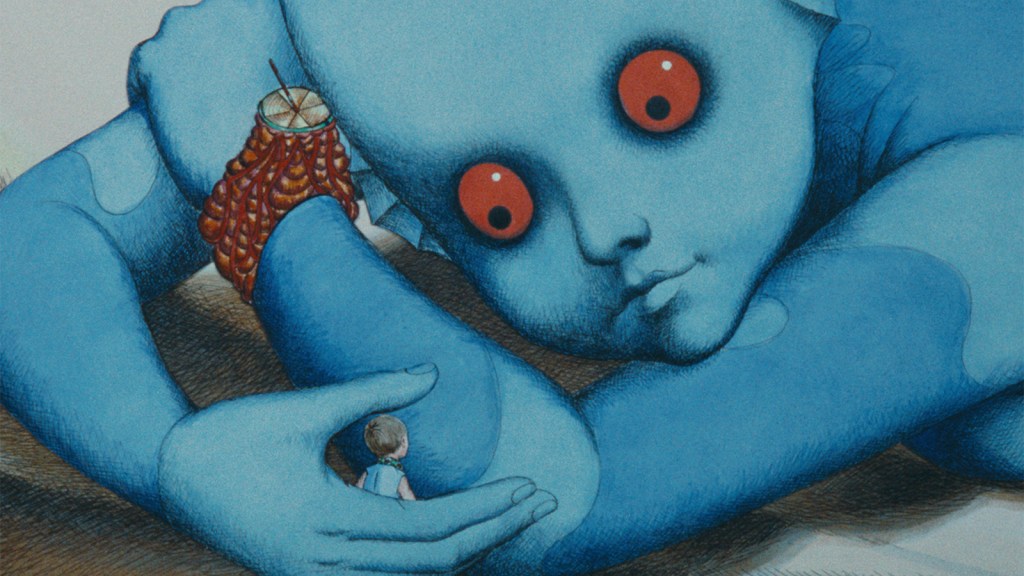
Dean: “Fantastic Planet is a terrible English-language title for this French-Czech co-production, but I’m kind of glad it’s so vague and non-indicative because it made its utter strangeness all the more surprising and thrilling. Ygam is an alien world ruled by colossal blue humanoids with fishlike features called the Draag, who maintain a peaceful and prosperous society, as long as you don’t count their regular cull of the tiny creatures called Oms, better known to us as human beings.
It is, in its basic setup, obviously allegorical – what if humans were the animals? – but it’s not obvious in execution and it’s ultimately both too specific and too withholding about its bigger picture to function as an allegory for anything in particular. It’s more like a myth from another world. And what a world it is, its surreal landscapes reminiscent of Bosch, Dalí and Magritte, appealing in its inscrutable but colourful oddness, repellent in its abhuman coldness. I truly do not get why an animator would ever strive for physical naturalism, let alone photorealism, when they could be letting their imagination off the chain like this.”
Mommie Dearest (1981)

Ciara: “Mommie Dearest has two different but related reputations: as one of the worst films ever made, and as a campy midnight-movie laugh riot. I find both of these perspectives borderline incomprehensible. Mommie Dearest is, despite what you’ve heard, sincerely a masterpiece – a harrowing and deeply sad portrait of child abuse and mental illness that lives in the grey area between melodrama and horror film.
Based on Christina Crawford’s memoir of abuse, Joan Crawford is portrayed as a bipolar and obsessive-compulsive alcoholic who adopts children for reasons that range from the cynical – it makes for a photo op – to the sincere – she wants to be the kind of person who is a good mother, and to give her children all the things she never had – to the twisted. She sees them as rivals, or as robots programmed to say ‘I love you, Mommie Dearest’ who keep malfunctioning, or as cruel sadists who make a ‘mess’ just to spite her. Motherhood is an attempt to rerun her own traumatic childhood but ‘win’ this time, and what winning looks like shifts in the breeze.
Faye Dunaway’s performance as Joan Crawford is breathtaking: easily the best performance ever to win a Razzie, a cohort that includes Tom Hanks in Elvis and Heather Donahue in The Blair Witch Project. It is an uncanny impression, but that is not to its detriment when in Dunaway’s hands, Joan Crawford, the character, is also playing the role of Joan Crawford. She carefully controls the image of herself she projects into the world even as she is constantly spinning out of control.”
Pulgasari (1985)

Dean: “In 1978, South Korean director Shin Sang-ok and actress Choi Eun-hee, a married couple, were kidnapped and brought to North Korea on the orders of Kim Jong-il, where they were essentially conscripted to both make films and develop the North Korean film industry. In 1985, they made a kaiju film.
I expected to like Pulgasari, not love it, but I do, because it rules. It’s a film where Gizmo eats metal and grows into Godzilla to help fight in a peasant rebellion against a monarchy so anti-farmer the flashpoint for the conflict is literally them turning ploughshares into swords. There are wacky stop motion lizard hijinks and scenes of brutal torture and public hanging. Despite all the stuff it reminded me of – Gremlins and Seven Samurai most of all – it’s also not quite like anything I’ve ever seen. Familiar rhymes and rhythms in a new arrangement.
People who present it as in part a not-that-veiled dig at the North Korean dictatorship are not wrong, as long as they include “in part”, because even that element of the film is folded back into its central theme: a plea for peace. To the extent Pulgasari himself is meant to represent the Workers’ Party of Korea, he’s still the hero of the film, it’s just that once he’s won the day, he needs to stop living or his endless hunger will destroy everything. It’s a dig at the WPK, yes: their saviour becomes their enemy. But it’s also, more fundamentally, about the cycle of war, and how maybe the only way to peace is starving war to death.”
His Motorbike, Her Island (1986)

Dean: “‘Some guys have vividly colored dreams, but mine were always in monochrome. This is the story of one of those monochrome dreams.’
So begins a tale of young love, fast bikes and shifting colour palettes that made me gasp out loud multiple times. Ko Kawasaki is a shiftless young motorcycle courier for a news agency, though it’s clear he only has the job to pay for having a bike. Happily unambitious and living for the open road, he’s reckless, feckless and carefree until he meets Miyoko.
When Miyoko sees Ko on his bike, a Kawasaki W3, it’s love at first sight – between her and the bike. She likes Ko too, and their summer courtship does blossom into love, but he’s uneasy about her growing fascination with motorcycles. She’s not a bad rider – quite the opposite, she’s a prodigy. And prodigies, he believes, always die on the road.
The film switches between rich black-and-white, vivid colour and subtle sepia, but it’s not as simple as each representing dream, memory and truth or something like that. There is a sense of the unreal in all three, and the overall effect is like a fairy tale about a woman so horny for motorcycles she would kill a man.”
The Insider (1999)

Ciara: “The Insider is a tough sell, because it’s a movie about if an episode of 60 Minutes will or will not air. But as it turns out, whether or not an episode of 60 Minutes will air is, in Michael Mann’s hands as director, inexorably tense and terrifying. It’s a true story of corporate malfeasance that will give you a stomachache.
Russell Crowe plays a scientist, formerly employed as one of the Big Tobacco giants, who is considering being a whistleblower. Before he even does anything or talks to anyone, the tobacco companies are putting bullets in his mailbox. Al Pacino plays a journalist who works for 60 Minutes, and whose doggedness is an unstoppable force that finally meets an unmoveable object: corporate greed. It wasn’t like I was walking around with a high opinion of Big Tobacco, but I still watched The Insider mouth agape. The overwhelming desire to make money, at all costs, to kill people for money, to threaten anyone who gets in your way, to make their life hell and bait them into suicide – I know that’s a reality of capitalism, but there’s knowing things intellectually and there is being made to feel them through a piece of art. The Insider makes us feel them. And it gives you little solace in return: when 60 Minutes airs, it’s too little, too late, because the only thing as powerful as corporate greed is everyone else’s cowardice.”
Josie and the Pussycats (2001)
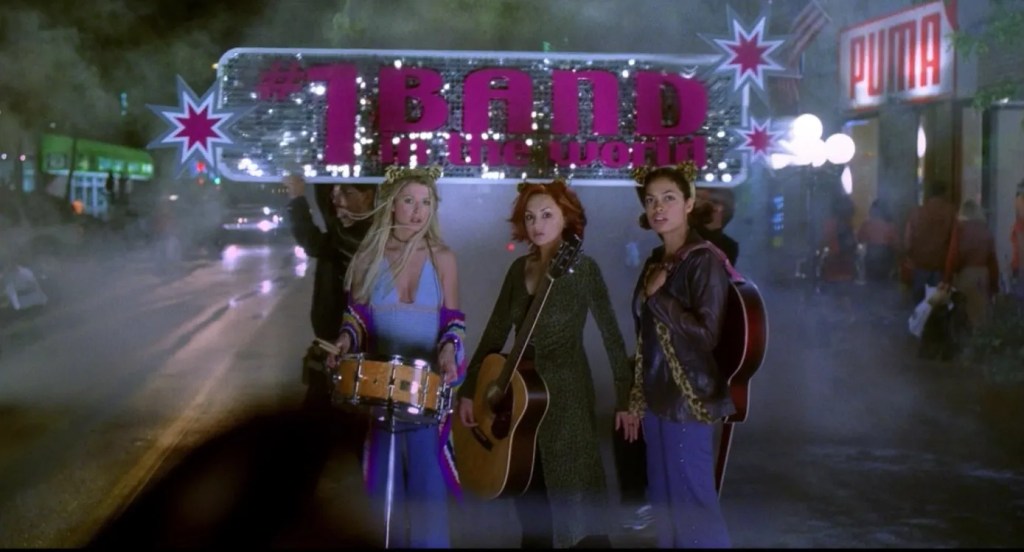
Ciara: “The thing about Josie and the Pussycats is that Harry Elfont and Deborah Kaplan made it and burned their nascent directorial careers to the ground just for me personally. Sorry it took me so long to get around to it, guys.
A friend put this on without telling me what we were watching, so in the opening minutes, I assumed it was some forgotten late 1990s/early 2000s boyband satire starring guys who were pretty famous at the time: Seth Green, Donald Faison, Breckin Meyer, etc. But then they ask their manager (Alan Cummings) about a strange backing track on their latest single, he tells the pilot to drive the chevy to the levee, and the world tilts on its axis. It seemed truly audacious. I imagine it’s how it felt to see the first Mission: Impossible movie on release.
The rest of the movie is a playful, borderline surrealist anti-capitalist satire with an original soundtrack that featured prominently on my 2024 Spotify Wrapped. It combines big comic set pieces – the fight scene! – with throwaway gags – the guy who got kicked out of The Captain and Tinelle, even though he was the one who had the idea for the Captain to wear a hat – for a joke density akin to the Zucker Brothers or The Lonely Island. But its comic voice is entirely its own. And totally jerkin’. I mean, at one point the Pussycats have to flee the murderers Carson Daly and Fake Carson Daly. The fake Carson Daly is a black guy who says that of course he’s Carson Daly, holding up his fingernails for inspection. Incredible.”
The Rest Is Silence (2007)

Ciara: “The most expensive Romanian film ever made (budget: two million Euro) is the story of the first Romanian feature film ever made. Partially because of that, partially because of the title, you may expect this to be very serious, maybe even a slog. But it is an incredibly funny, charming romp, with just a tinge of tragedy at the end as salt on the caramel. I loved it with the purest kind of cinematic love, knowing deep inside that in a different time and place The Rest is Silence might have been that special film that rewrote my brain chemistry and made me see cinema in a new way. But in this time and place, it made me flap my hands and punch the air and laugh and laugh and laugh, and that is all I could ask for.
It’s 1911, and an aspiring director ropes in a somewhat disreputable patron to make a feature-length movie about the Romanian War of Independence. Location shoots, hundreds of extras, and nobody who really knows what they’re doing. In The Rest is Silence, making the first feature film in Romania has all the fun and anxiety of a great heist. The tactics they resort to in order to get the film made always feel like getting away with something, from the scam-adjacent to outright fraud. The filming process is a comedy-of-errors farce as a bunch of people who’ve never made a movie try to figure out in real time how to make a movie.”
Edge of Tomorrow (2014)

Ciara: “Like many people, I missed Edge of Tomorrow when it came out. I feel like I only started hearing that it was good when it was too late to go see it, and I was still confused about if it was called Edge of Tomorrow or Live. Die. Repeat. But I’m a Tom Cruise head now – I’m on the committee to re-elect him as President of Movies – so naturally when it was rereleased for its tenth anniversary, I checked it out.
The film takes place a couple of years after an alien invasion, during a war that sees the entire earth united against a common enemy. Cruise plays Major William Cage, a slick office guy who is technically in the military but works exclusively in the marketing department. He gets stuck in a time loop, allowing Cruise to run the gamut from there to ultimate action hero – like seeing Jerry Maguire turn into Maverick. He’s also completely hilarious: I will go to my grave thinking about his delivery of ‘great presentation’ after he receives the necessary expository infodump.
Edge of Tomorrow is a perfect film. The best Groundhog Day movie since Groundhog Day. It’s hard to explain what makes it so great because so much of it is the simple, obvious, intro-to-screenwriting stuff: the world-building is so effective, Cage’s character development is so vivid, you really feel the weight of how many loops he goes through until he becomes a soul-exhausted ghost of himself. But it’s the simple and obvious things that so many movies don’t bother getting right, and that Edge of Tomorrow delivers with such elegance, humour, emotion, and panache.
And it ends on one hell of a punchline.”

 The Sundae