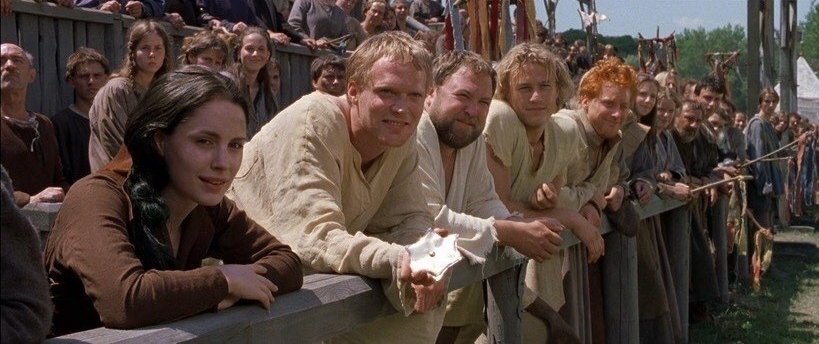
The critical reception to 2001’s A Knight’s Tale is full of terrible, lazy takes deriding it as mind-numbing trash. They’re full of disdain for low culture that places the film’s detractors squarely on the side of the its villains, a comparison that seems utterly lost on the whole pompous lot. The presumed audience of the film – teenagers – gets as much scorn as the film itself. The reviewers then scorn the film all the more in turn for its “pandering”. There are tons of complaints about its anachronistic 70s rock soundtrack, though some of the same reviewers, like Entertainment Weekly’s Lisa Schwarzbaum, would go on to name Moulin Rouge one of the best films of the year.
Admittedly, A Knight’s Tale isn’t as good as Moulin Rouge: this isn’t one of those articles where I try to convince you a largely dismissed piece of trash is actually a masterpiece. A Knight’s Tale is a pretty good popcorn flick, well-cast and competently made, with a straightforward plot and some good set-pieces. Reviewers were fond of referring to it as a “Middle Ages Rocky” or “Rocky on horseback” with exactly the tedious predictability they accuse its plot of epitomising, which is weird for two reasons: first, because Rocky is a gritty minimalist drama, and second, because, somehow, the comparison never made them consider that A Knight’s Tale, much like Rocky, is a film about class.
Continue reading “Scenes from the Class Struggle in Medieval Europe”
 The Sundae