I Just Hope I Don’t Get More Out of This Than You Do

It’s been almost three years since one of the worst webcomic artists in the world published one of the worst webcomics of his career. The artist is Adam Ellis, formerly of Buzzfeed, whose work is likely familiar to anyone who’s ever used Facebook: it may well be mathematically impossible at this point to go a whole hour on Facebook without catching sight of his bug-eyed self-insert in a “relatable” and yet “funny” scenario. The comic in question was posted to Twitter with the caption “shhh” and depicts one of those deeply unfunny people who thinks not liking or knowing much about sport is a personality being silenced by an American football fan who tells him to “let people enjoy things”.

I loathe it more than most of his awful, awful work because, while I find “sportsball” types risible, it can’t mount a more thoughtful objection to their behaviour than “let people enjoy things”. It’s a nice slogan, but obviously a terrible blanket policy when people enjoy lots of bad things, and not just aesthetically bad, but morally bad. But even when there’s arguably not a significant, urgent moral dimension to something people enjoy, the “let people enjoy things” mantra makes me nervous. It’s one thing as a response to someone who’s snobby or pushy with criticisms of your likes or interests on an interpersonal level, the kind of people who comment on how unhealthy your food is or rag on the shows you like for no reason. But at any more macro level, like in online cultural discourse and, increasingly, in professional critical writing, it eventually becomes a way to deflect unflattering critiques or is so internalised that it pre-empts criticism at all.

Of course, Ellis and his comic aren’t responsible for the rise and spread of this attitude in online cultural discourse – how could it be, when Ellis’s work consists almost entirely in arriving three years late to observations that were already trite the first time they were verbalised? – but it’s emblematic of it in a way little else is, and for that, I hate it.

Continue reading “I Just Hope I Don’t Get More Out of This Than You Do”
It’s a Little Childish and Stupid, But Then, So Is High School

Here’s a brief cultural history of “the villain is actually right” hot takes, as I understand it. People were like “What if Claudius is the real hero of Hamlet? Makes you think” and it didn’t really stick. Then a couple of hundred years passed and someone pointed out Walter Peck from Ghostbusters was obviously correct to not let the Ghostbusters run a nuclear reactor without permission, and it got clicks, so people were like “I wonder if I can do that with other eighties movies” – haven’t you ever noticed it’s always eighties movies? – and now we live in a world where three people in the comments of an already terrible article about why some eighties bad guys were the secret heroes of their movies suggested Mr Vernon from The Breakfast Club be added.

Just in case you’ve forgotten, this is a man who threatens a teenager with assault before leaving him locked unsupervised in a closet. I understand why unscrupulous click-hungry hucksters publish this rubbish, but the traction it gets online is baffling and a little scary, to be honest. I know that people disregard and even hate teenagers, consistently treating their problems as if they didn’t matter and then acting shocked – SHOCKED, I tell you – when they kill themselves at higher and higher numbers. I know this, I’ve written about it before, I’ll probably write about it again. But, I have to admit, I don’t understand why. I don’t see what anyone gets out of shitting on teenagers except, I guess, the grim, bloodthirsty satisfaction of kicking someone while they’re down. People do like to just hate and hurt other people for its own sake, though they also tend to come up with ad-hoc rationalisations for it, so they don’t have to acknowledge their own sadism. Maybe the reason so many people get older and suddenly start yammering about how the antagonistic authority figures of teen movies were actually the heroes all along is because it lets them tell themselves they’re still the heroes of their own lives, now that they’ve become the villains of their adolescence.

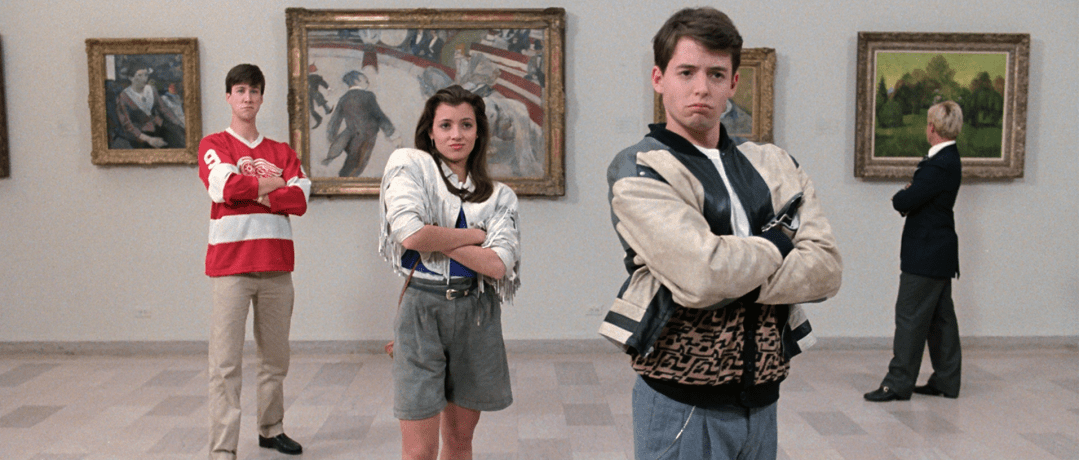
Ed Rooney is not the secret hero of Ferris Bueller’s Day Off.

Continue reading “It’s a Little Childish and Stupid, But Then, So Is High School”

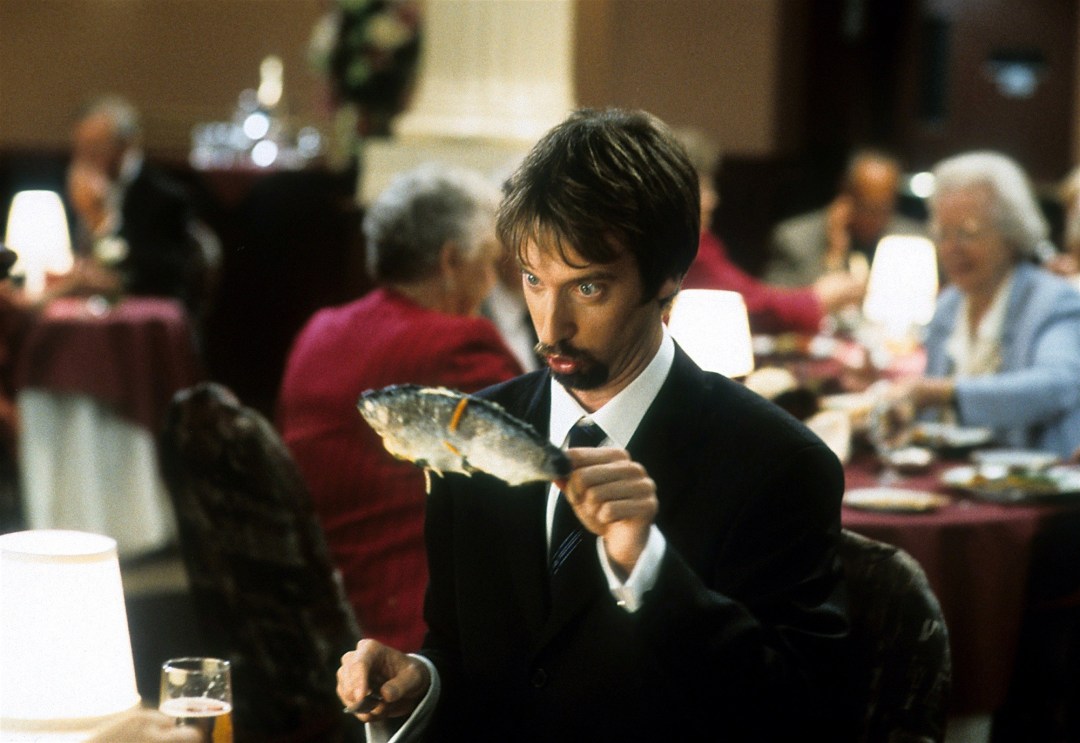
You Should Watch Freddy Got Fingered

Freddy Got Fingered is generally considered one of the worst films ever made. Roger Ebert said it “doesn’t scrape the bottom of the barrel… This movie doesn’t deserve to be mentioned in the same sentence with barrels.” Leonard Maltin called it “the poster child for all that’s wrong with movie comedy.” CNN’s film critic Paul Clinton said it was “quite simply the worst movie ever released by a major studio in Hollywood history.” The Toronto Star literally gave it negative one star out of five.

There was some dissent at the time – most notably from AO Scott, who wrote that the film’s “comic heart consists of a series of indescribably loopy, elaborately conceived happenings that are at once rigorous and chaotic, idiotic and brilliant” – and since, including a glowing retrospective by Nathan Rabin in The AV Club. But it has yet to reach the critical mass of a cult following to get a director’s cut released, so I’m here to do my part.

Freddy Got Fingered is a masterpiece.

Continue reading “You Should Watch Freddy Got Fingered”

Scenes from the Class Struggle in Medieval Europe

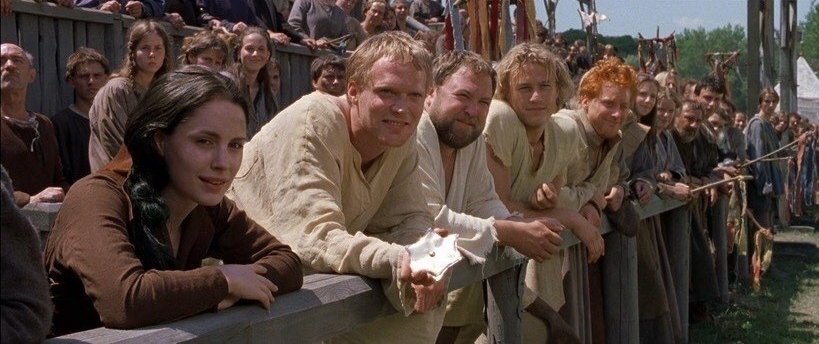
The critical reception to 2001’s A Knight’s Tale is full of terrible, lazy takes deriding it as mind-numbing trash. They’re full of disdain for low culture that places the film’s detractors squarely on the side of the its villains, a comparison that seems utterly lost on the whole pompous lot. The presumed audience of the film – teenagers – gets as much scorn as the film itself. The reviewers then scorn the film all the more in turn for its “pandering”. There are tons of complaints about its anachronistic 70s rock soundtrack, though some of the same reviewers, like Entertainment Weekly’s Lisa Schwarzbaum, would go on to name Moulin Rouge one of the best films of the year.

Admittedly, A Knight’s Tale isn’t as good as Moulin Rouge: this isn’t one of those articles where I try to convince you a largely dismissed piece of trash is actually a masterpiece. A Knight’s Tale is a pretty good popcorn flick, well-cast and competently made, with a straightforward plot and some good set-pieces. Reviewers were fond of referring to it as a “Middle Ages Rocky” or “Rocky on horseback” with exactly the tedious predictability they accuse its plot of epitomising, which is weird for two reasons: first, because Rocky is a gritty minimalist drama, and second, because, somehow, the comparison never made them consider that A Knight’s Tale, much like Rocky, is a film about class.

Continue reading “Scenes from the Class Struggle in Medieval Europe”

Some Unspoken Thing: In Praise of Guardians of the Galaxy Vol. 2

For at least a decade, we’ve lived through a pretty unprecedented boom in superhero films. Disney releases three Marvel Cinematic Universe films a year, Warner Brothers is trying desperately to make the limping DC universe hold together, Fox has the X-Men, and that’s not counting failed experiments like Fantastic Four or Sony’s Spider-Man universe, which, as far as I understand, they’re attempting to still do, but without Spider-Man. Superheroes aren’t suddenly popular out of nowhere or anything, but the sheer glut of superhero movies being produced now makes the progenitors of the superhero boom – like Christopher Nolan’s Batman trilogy or Sam Raimi’s Spider-Man – look modest by comparison.

It’s no secret that I’ve been critical of the superhero boom. I would support a ten-year ban on producing superhero films if such a thing were possible. But that isn’t out of snobbiness, or even out of a dislike of superhero films. I think Spider-Man 2 is a masterpiece. I saw The Dark Knight Rises in the cinema twice and think anyone who criticises its many plotholes is a pedantic killjoy. I think Logan had one of the best screenplays of last year. But the superhero boom is a feature of a much bigger problem: a trend in blockbuster filmmaking, and popular cinema in general, away from the thoughtful, interesting and weird and towards bland, hollow pleasures. It started with superheroes, and now it’s creeping all over the place, from Star Wars to the Universal monsters.

Superhero films tend to get a disproportionate amount of praise because they’ve spent a decade wearing us down, calibrating our expectations to just the right frequencies. I hate the word “overrated,” but I don’t think there’s a better word to explain the phenomenon of every Marvel release apparently being one of the best films ever made, if Rotten Tomatoes scores are anything to go by (and they aren’t). I really liked Wonder Woman, even if it had third act problems, but when people started talking about it as one of the best films of the year and it being “snubbed” by the Oscars, I felt like I was going insane. So I’ve never felt the need to speak up for a superhero film, really.

But then there’s Guardians of the Galaxy Vol. 2.

Continue reading “Some Unspoken Thing: In Praise of Guardians of the Galaxy Vol. 2”

Can You Believe It: Trump and Political Comedy

If you like comedy, but you’re tired of Trump jokes, the last couple of years have been frustrating. Your choices for political comedy on American television range from The Daily Show, which is pretty much all about Trump, to three different shows from Daily Show alumni – Last Week Tonight with John Oliver, Full Frontal with Samantha Bee and The Opposition with Jordan Klepper – which are also pretty much all about Trump. John Oliver’s turn towards Trump is particularly irritating because his show made its reputation on in-depth examinations of underdiscussed issues, like patent trolling, public funding of stadiums and the exploitation of chicken farmers, and had made a point of largely ignoring Trump for months before gradually becoming yet another Show Against Trump.

Shows without an explicit political bent offer no escape: Saturday Night Live features Trump so frequently that Alec Baldwin will likely be eligible for the Supporting Actor Emmy again this year, even though he’s ostensibly a guest star. The Late Show with Stephen Colbert does so much Trump material it was able to spin-off a recurring animated segment called Our Cartoon President into its own TV show. Colbert was always going to be more political than the average late-night host, except he’s actually not that much more political than the rest anymore: Seth Meyers does a weekly politics segment on Late Night called “A Closer Look” which is, of course, mostly about Trump and Jimmy Kimmel is constantly taking cracks at him. Even that spineless hair-ruffling weasel Jimmy Fallon has started to do regular Trump jokes now, and he’s Jimmy Fallon, the most inoffensive man who’s ever existed.

Continue reading “Can You Believe It: Trump and Political Comedy”

Notes on Split

I went to see Split on my twenty-third birthday, and I was very excited. That was partly because my birthday was the day Donald Trump was inaugurated as President and it was a way to not think about, you know, events. But it was mostly because I am an M. Night Shyamalan apologist, and he was back! I love The Sixth Sense and Unbreakable and The Happening, and after a string of bad decisions, he was resurgent. He’d had a surprise hit on television with Wayward Pines and his previous film, The Visit, had been both well-received and profitable. Now it was time for his redemption story to go mainstream with his biggest success since Signs.

And it did.

Measured by return on investment, Split was Shyamalan’s most profitable movie, turning $9 million into over $250 million, and it received some of the best reviews of his career. It was number one at the US box office for three consecutive weeks (a record in Shyamalan’s filmography matched only by The Sixth Sense), it had a sequel greenlit by April, and James McAvoy is one of the year’s prototypical examples of an actor locked out of the Oscars race by genre rather than merit. M. Night Shyamalan brought his reputation back from the dead with one of the year’s most successful movies.

And I hated it.

Continue reading “Notes on Split”

Weekend at Bernie’s Is Not the Film You Think It Is

Weekend at Bernie’s might be the most misunderstood film I know. It was a hit in 1989, despite bad reviews, and has had staying power since: the image of Andrew McCarthy and Jonathan Silverman propping up Bernie’s lifeless body is seared onto the cultural memory, one of those iconic cinematic images that has been parodied and homaged and referenced enough to take on a life of its own beyond the film itself. It’s a very famous film, is the point – though not exactly acclaimed – but when I watched it, I kind of felt like the first person to ever see it.

Here’s what I assumed Weekend at Bernie’s would be like: an extremely dumb, extremely wacky 1980s comedy, in the vein of Porky’s or a National Lampoon movie, that is probably not very good but has a kind of charm that not very good films from the 1980s tend to have. I knew the basic plot – two guys pretend another guy, Bernie, is alive, while staying at his place for the weekend. I assumed – either because it’s how it turns out in any given Weekend at Bernie’s-inspired TV episode, or because of the existence of Weekend at Bernie’s II – that Bernie wasn’t really dead. That our heroes found him unconscious and panicked, but, by the end of the film, Bernie would wake up, and we’d arrive at our happy ending.

Weekend at Bernie’s is something much stranger, and much more interesting.

Continue reading “Weekend at Bernie’s Is Not the Film You Think It Is”

You Should Watch Charlie Chaplin

It’s 2017, and silent films are dying.

Silent films started dying in 1927, of course, when The Jazz Singer mainstreamed the use of synchronised dialogue – although it itself was a sound-silent hybrid, mostly using sound in the sections to do with musical performance. By the 1930s, basically all films were talkies, and apart from occasional blips – Mel Brooks’ Silent Movie or best picture winner The Artist – we’ve never looked back. Silent films have been dead for almost a hundred years, and there’s no good mourning them now.

But there’s the second death – the death that occurs when something once vibrant and alive is forgotten by everyone living. That time will come for everything and everyone, but there’s an artificial acceleration when an art form has fallen out of use. Charles Dickens is as popular and well-known as ever, but he mightn’t be if everyone had stopped writing or reading novels for a hundred years. He mightn’t have been had it not been possible to publish his serials in the form of the novel, instead of leaving them scattered across the volumes of history. Silent films are still films, but they’re different in a pretty fundamental way, in a way that seems impossibly big if you’ve never seen one.

So I’m really worried – unreasonably worried – that people are going to forget Charlie Chaplin.

Continue reading “You Should Watch Charlie Chaplin”