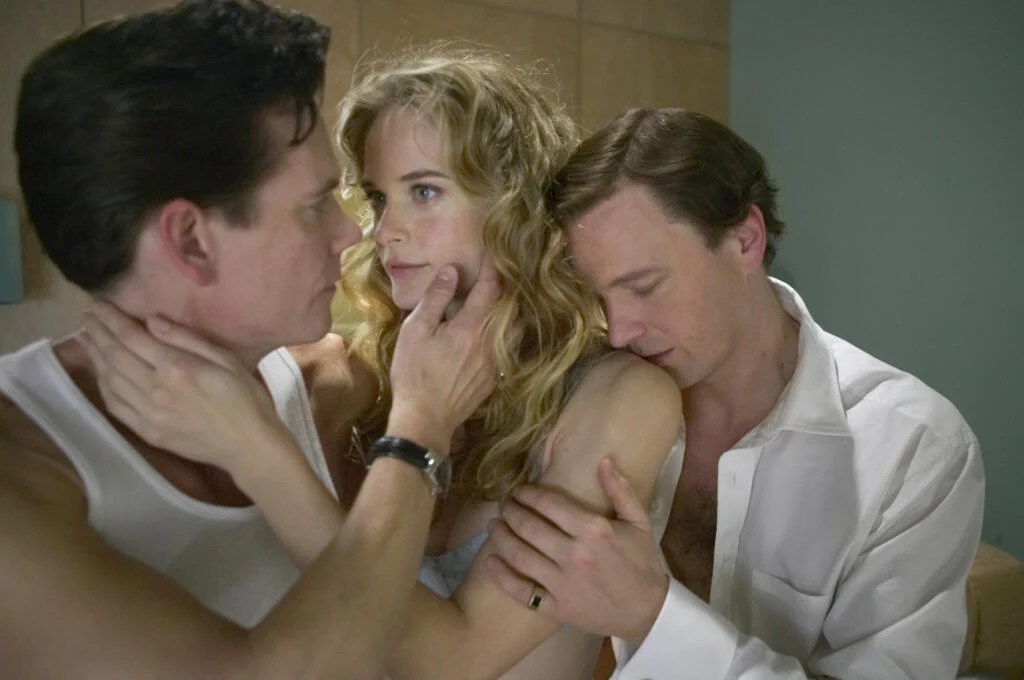
This article is part of the Notes on Failure series, which discusses interesting cinematic failures. Previously, The Conjuring.
As I threatened to at the end of last year, I have gotten way into Martin and Lewis. I have watched all their movies and a bunch of Colgate Comedy Hour, and read Dean & Me: A Love Story, Jerry Lewis’s memoir about his partnership with Dean Martin. I have bored the pants off people by subjecting them to irrelevant Martin and Lewis anecdotes.
So, naturally, I carved out a couple of hours to watch Where the Truth Lies. Adapted from a novel by Rupert Holmes (of ‘Escape (The Piña Colada Song)’ fame), it’s a queer fictional take on Martin and Lewis’s break-up – a ‘90s erotic thriller half a decade late. By rights I should love it no matter how bad it is. But Where the Truth Lies is not just bad, it’s baffling. Top to bottom, it’s full of insane decisions at basically every level of filmmaking.
Here’s why:
- In real life, Martin and Lewis broke up acrimoniously ten years after they first got together. It’s been oddly airbrushed out of cultural history, but it’s hard to oversell how big Martin and Lewis were – the only real comparisons are rockstars: Elvis, The Beatles, that kind of league. Then, the story goes, they didn’t speak for twenty years before reuniting on the 1976 MDA telethon. The reasons for their breakup are both well-documented and mysterious. We know “why” – Jerry the egomaniac bullying everyone around him, Dean the claustrophobic choking on their unrelenting proximity – but we don’t know why: like Ethan Hawke wrote about John Lennon and Paul McCartney, “I know, I know, I know, it has nothing to do with me, but damn it, tell me again why love can’t last. Why do we give in to pettiness? Why did they? Why do we so often see gifts as threats? Differences as shortcomings? Why can we not see that our friction could be used to polish one another?”
- In Where the Truth Lies, that mystery is intertwined with a murder mystery: right before they break up, a girl is found dead in the bathtub of their hotel room in New Jersey. She disappeared in Miami, where the Martin and Lewis equivalents had just been. Her death is attributed to an overdose, and the double act breaks up.
- Kevin Bacon plays Lanny Morris, the Jerry Lewis analogue, and Colin Firth plays Vince Collins, the Dean Martin analogue. This is bizarre casting. It’s weird for Kevin Bacon and Colin Firth to even be in the same movie, but casting an English guy who can’t sing as Dean Martin? Crazy.
- You can try to write this off by reminding yourself that they are not actually playing Martin and Lewis, but even if you put actual Martin and Lewis aside, there’s this huge gap between the characters as written and as played by Firth and Bacon. Lanny gets heckled by antisemites, and one just has to wonder what kind of sixth sense this guy has to straight off the bat think a character played by Kevin Bacon is Jewish.
- Even worse is that they are not funny. Not one bit. They suck. They suck so bad it made me wonder if the movie thinks that Martin and Lewis sucked. And I understand that recapturing the once-in-a-generation chemistry of Dean and Jerry is nigh impossible, but you’d think that they would try to ensure that they were funny enough to sell why they were popular – or, failing that, don’t show them actually performing: do the old divine-presence-to-be-added-later, Jesus-in-Ben Hur, Michael-Jordan-in-Air thing. But don’t show lots of them performing and not being funny at all.
- There are moments where the things that make Martin and Lewis so compelling to me glimpse through: Lanny saying they were a boy-girl act with two boys makes my heart sing to this day. But mostly, it’s the outer signifiers of Martin and Lewis with almost none of the heart and soul. They’re recognisable as Martin and Lewis analogues, but their eyes don’t brim with love when they look at each other.
- But in a lot of ways that’s besides the point, because the movie’s not about Jerry and Dean. It’s about Girl Journalist (Alison Lohman as Karen O’Connor). The most boring character of all time. And everything interesting that happens is presented through her, how it makes her feel. For some fucking reason.
- Girl Journalist is ghostwriting Vince’s memoir. If that makes it sound like it might have a Citizen Kane type structure, with the journalist assembling the narrative of what happened, please know that mostly she sleeps with Kevin Bacon and Alice in Wonderland (don’t ask) and does terribly written voiceover.
- She also sleeps with Lanny after meeting him on a plane, and she is very upset about him not leaving a note. That’s the main narrative, and there are flashbacks throughout that are chapters from Vince and Lanny’s competing memoirs.
- About the plane: there is this insane scene where the flight attendant explains all the cool features the journalist’s seat has. How you can swivel the direction and all this shit. This is all just to set up that Lanny sitting in front of her turns his seat around and they have their meal together. I felt like I was going crazy.
- Anyway, she’s a bad journalist in so many ways: a bad investigator, a bad interviewer, a bad writer. She repeatedly bumps up against scoops and runs the other way. (Martin and Lewis reunite in front of her eyes! She coulda Frank Sinatra’d that shit! And she runs because she’s embarrassed about Lanny sleeping with her and not leaving a note.) It’s a miracle she figures out the mystery based on more or less nothing.
- God, the mystery. This fucking mystery. Which the whole movie is built around. The establishment that it is somehow lobster-related – when Lanny is served lobster at a restaurant, he freaks out, saying “I don’t eat lobster!!!” – comes so long before the reveal of how it’s lobster-related that it felt like I was losing my mind. Like, did she choke to death on lobster? Did she think she was a lobster and climb into the lobster box? What?
- Their story of what happened that night – an orgy, essentially – falls apart when Vince uses the exact same wording as Lanny did: “babes on hand – well, not on my hand, that wasn’t my preference…” This is an extremely lame and cringe gag to expose the lie, but in fairness, this is a universe where Martin and Lewis weren’t funny.
- Vince kills himself, and then we find out what happened in the form of a vaulted chapter from Lanny’s memoir. That scene is the best thing in the movie. The girl who ends up dead in the bathtub interviews Vince and Lanny for her college newspaper, tape recording running, and ends up having sex with both of them. Vince slides in behind Lanny while he’s fucking her. He tries to frame what he does as casual, almost accidental – saying that it’s hard to tell who’s who in the mish mash of bodies – but he’s attempting to fuck Lanny. And Lanny blows up at him: “We don’t do that! I love you, we’re partners, we’re pals, but we’re not queers!” It feels like it has happened before. The film comes to life in that moment. How Lanny says he loves him – so it’s not “you’re gross,” it’s “we don’t do that together, that’s not what our relationship is, but that’s not because it’s anything less.” They love each other equally deeply, even if it’s not in the exactly the same way.
- In Lanny’s account, Vince killed the girl to keep his secret. And Lanny went along with covering it up. But the truth – which the journalist surmises when Lanny’s fix-it man asks for money for the tape from that night – is that there was a third guy in the room the whole time. Lanny’s fix-it man. And he did it. He also, and this is almost more important, took the note that Lanny left for the journalist after they slept together. Also, he was extorting Vince for a million dollars, which is why Vince was doing the memoir.
- I don’t at all understand why the journalist says that Lanny’s account would be worthless without the tape. She literally says that the fix-it guy sent her the chapter to drive up her demand for buying the tape. And, like, obviously it’s better with the tape, but what?
- So, essentially, Lanny and Vince both thought the other guy killed her, and both covered it up for the other’s benefit, and that pushed them apart. And that’s sort of interesting, but as a starting point, not an ending. It’s this insane act of love that we only know about sort of by accident. Or by process of elimination.
- Also, the dead girl’s mother thinks all her dead family are in hell and her daughter is a tree now. The movie ends with the journalist saying she won’t reveal the truth until all the people who could be hurt by it are dead, and then she says in voiceover that she meant the mother. Wholly bizarre.
- But most importantly, when we flash back to the polio telethon, the journalist appeared on it as a kid with literally her same face. Embarrassingly shite.

 The Sundae
Thank you for saying what I felt when I watched this awful movie.
LikeLike